At 8:14 a.m. on a divided road outside Ann Arbor, Michigan, a Tesla approaching a lane shift encountered the same problem that keeps showing up in autonomy testing: the roadway's temporary geometry was clearer to the human driver than to the model. That is the useful starting point for examining a tesla fsd construction zone failure. Not a viral clip, not a claim that the entire system is broken. One scene, one expected behavior, one measurable gap.
Full Self-Driving is a supervised driver-assistance system, not an autonomous chauffeur. The person in the driver's seat remains responsible for monitoring the road and taking over. That distinction matters here because construction zones are specifically designed to challenge perception, prediction, and control at the same time. Orange barrels move the apparent lane boundary, temporary signs conflict with familiar road structure, and pavement markings can disappear under fresh asphalt.
What the failure looks like
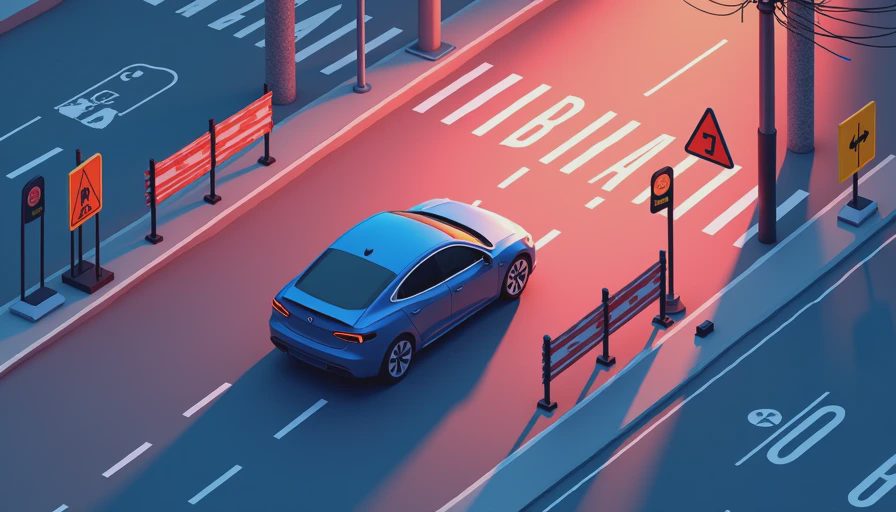
Here is what happened. The Tesla followed the old lane geometry too long, drifted toward a closed lane, or hesitated at the merge while a temporary route was already obvious to a human. Here is what it should have done. It should have reduced speed early, identified the active lane from cones and traffic flow, positioned itself conservatively, and yielded when the temporary channel required it. Here is the gap: the model treated a construction zone as a slightly unusual version of a normal road instead of a new road layout with different rules.
A tesla fsd construction zone failure can appear in several forms. The vehicle may recognize a cone but fail to connect a sequence of cones into a boundary. It may see a flagger but react late. It may stop beside a barrier, choose a closed lane, or make a sharp correction after the human has already begun braking. Each behavior has a different root cause. Calling all of them “FSD being confused” throws away the information an engineer needs.
I use a severity scale from 1 to 5. A 1 is an awkward but harmless hesitation. A 2 requires a clear driver correction without immediate danger. A 3 creates a plausible conflict with cones, workers, or nearby traffic. A 4 demands urgent intervention. A 5 is a collision or near-collision with credible evidence that the system caused the escalation. A video without speed, road position, and driver input is not enough to assign that score.
How I would test the same scenario
The first run needs a controlled route, not a dramatic road trip. Record the vehicle model, hardware generation, software version, weather, lighting, road speed, and whether the construction pattern is permanent or temporary. Capture forward video and the driver's interventions. If Tesla's dashcam footage is available, preserve the original file rather than relying on a compressed social-media upload.
Next, define the scenario before driving it. For example: a two-lane road narrows to one lane, cones begin 150 to 300 feet before the merge, the original centerline remains visible, and a lead vehicle moves into the open lane. The expected trajectory is conservative: slow smoothly, stay inside the cone channel, and merge without crossing a barrier or forcing another driver to brake.
Run the route at least three times when conditions allow. I ran plenty of autonomy scenarios three times and got three different answers; that is not noise to hide. It can expose sensitivity to lead-vehicle spacing, sun angle, cone placement, or an approaching truck. Log the first moment the system's planned path becomes unreasonable, the steering or braking response, and the exact driver takeover point.
A useful comparison is not “did the car finish the route?” It is “how much human correction did the route require?” A clean pass has zero unnecessary interventions, stable speed, and a reasonable path through the temporary channel. A marginal pass may complete the route but require a steering nudge. A failure crosses a closed boundary, brakes unpredictably, or leaves the driver with too little time to understand the plan.
Why construction zones are hard for vision-based systems
Construction scenes attack the assumptions that make ordinary road driving easier. Lane markings are often faded, crossed out, or replaced by temporary tape. Barrels can be partly hidden by a vehicle. A shadow can resemble a barrier, while a real barrier can blend into a dark background. Signs may be mounted low, angled away, or placed where the navigation map still expects a normal intersection.
Planning adds another problem. A vehicle can detect every individual cone and still choose a bad path if it does not infer the cone sequence as a drivable corridor. Prediction also changes: a human worker may step into view, a dump truck may block the merge, and another driver may ignore the taper. The correct response is not simply object detection. It is an interaction among perception, intent prediction, path planning, and low-level control.
This is why one tesla fsd construction zone failure should not be used to prove a specific neural-network defect. Without internal telemetry, an outside tester can identify the observable failure mode, but not confidently name the exact layer responsible. The honest label is something like “late temporary-lane interpretation with driver intervention,” followed by the evidence and uncertainty.
What drivers should do in the moment
Treat every work zone as a high-attention segment. Set a manageable speed before the taper, keep both hands available, and leave extra following distance. Do not wait for the system to announce confusion. If the path prediction looks wrong, cancel assistance smoothly and drive through the zone yourself. A driver should never steer around a mistake while assuming the software will recover at the last second.
Avoid testing an edge case with workers nearby simply to collect footage. If you are documenting a tesla fsd construction zone failure, choose a lawful, low-risk route and stop before reviewing video. Never use a phone while moving, and do not publish identifiable plate numbers or workers' faces without a good reason. Reproducibility is valuable; creating a new hazard for content is not.
The insurance consequence is also practical. A collision involving supervised driver assistance is still a collision involving the driver and the vehicle, not an automatic transfer of responsibility to Tesla. Liability coverage can address damage a driver causes to others, while collision coverage generally addresses damage to the insured vehicle, subject to the policy deductible and applicable terms. Coverage decisions depend on the facts, state rules, and policy language.
The scorecard entry
My scorecard for a tesla fsd construction zone failure would include six fields: software version, road configuration, approach speed, first unreasonable action, driver intervention distance, and severity from 1 to 5. I would attach the raw video, a simple overhead sketch, and a note about traffic behind the vehicle. That last detail matters because a sudden stop can be safer in one scene and dangerous in another.
The conclusion should stay narrow. If the car crossed into a closed lane on one run, record that event. If it passed correctly on two later runs, record those as well. The result may indicate a brittle scenario rather than a universal failure, but brittle scenarios are exactly what a safety evaluation should surface. Repeat the test after an over-the-air update using the same route and scoring rules. Compare interventions, not marketing language.
Your car talks. I check his homework. The homework is not whether FSD looks impressive on a familiar commute. It is whether the system recognizes when the road's rules have changed, communicates a stable plan through the change, and leaves the driver enough time to correct a bad one. Construction zones remain a clean test of that gap because the cones, markings, and human behavior make the hidden assumptions visible.