At 7:42 a.m. on Washtenaw Avenue in Ann Arbor, I watched a production driver-assistance system hesitate at a parked delivery van, then steer toward the centerline before correcting. The event lasted less than three seconds. It was not a dramatic failure. It was more useful than one. The search phrase autonomous autonomous looks like a typo, but it points at a real problem: people use vague labels for systems that need precise tests.
I do not score a vehicle based on how futuristic the dashboard looks. I record what the system saw, what it predicted, how long it took to act, and whether the trajectory made sense. Your car talks. I check his homework.
Why the duplicated phrase matters
Autonomous autonomous is not a recognized technical category. In a search box, it could be a duplicated keyword, a bad transcription, or someone trying to find information about autonomous driving twice as fast. That ambiguity is exactly why labels are dangerous. A vehicle advertised with an autonomous-sounding name could contain anything from a lane-centering aid to a limited automated driving system.
The important distinction is operational design. Level 1 assistance controls either steering or speed. Level 2 systems can control both under defined conditions, but the driver remains responsible and must supervise continuously. A system that performs a lane change without asking is not automatically capable of handling a construction zone, a stopped emergency vehicle, or an occluded pedestrian.
When I see autonomous autonomous in a query, I translate it into testable questions. What sensors are active? What roads are supported? Does the system detect its own limits? How does it request a takeover? What happens when the driver does nothing for five seconds? Those answers matter more than a badge on the trunk.

My test harness and scoring method
My harness combines dashcam video, CAN-derived vehicle signals when available, timestamped driver inputs, and a written scenario log. I run the same route repeatedly rather than collecting one impressive clip. A run starts with a pre-drive checklist: weather, road surface, software version, map state, tire condition, and traffic density. If an over-the-air update changes behavior, I archive the prior result instead of overwriting it.
The scorecard uses a five-point severity scale. Severity 1 is an untidy but harmless decision, such as a late speed adjustment. Severity 2 requires driver attention but leaves a comfortable recovery margin. Severity 3 creates a plausible conflict with another road user. Severity 4 demands immediate intervention. Severity 5 means contact, a near miss, or a system action that a reasonable driver could not safely recover from.
I also measure latency. A camera may identify a cyclist quickly, while the planner still selects a trajectory that passes too close. Perception accuracy alone does not rescue a poor decision. Autonomous autonomous evaluations should therefore report the complete chain: detection, prediction, planning, control, and driver alerting.
A repeatable corner case: the blocked lane
At 8:15 a.m. last fall, I tested a vehicle approaching a right lane blocked by a utility truck. Cones narrowed the lane gradually, and a worker stood near the taper. On the first pass, the vehicle slowed smoothly and followed the open lane. On the second, traffic approached from behind and the planner held position too long. The driver had to intervene before the lane ended. On the third, the system changed lanes earlier but crossed a faded marking.
Here is what happened: behavior changed with surrounding traffic and the available gap. Here is what it should have done: recognize the blocked lane early, identify a legal and comfortable gap, and commit without drifting over uncertain markings. Here is the gap: the system treated the scenario as a timing problem, but the real challenge was uncertainty about road geometry.
I rated the second run Severity 3. Nothing hit anything, and there was no cinematic near miss. Still, a driver who trusted the marketing language instead of supervising would have had little time to respond. That is the kind of event a benchmark should preserve, not edit out.
What an OTA update can change
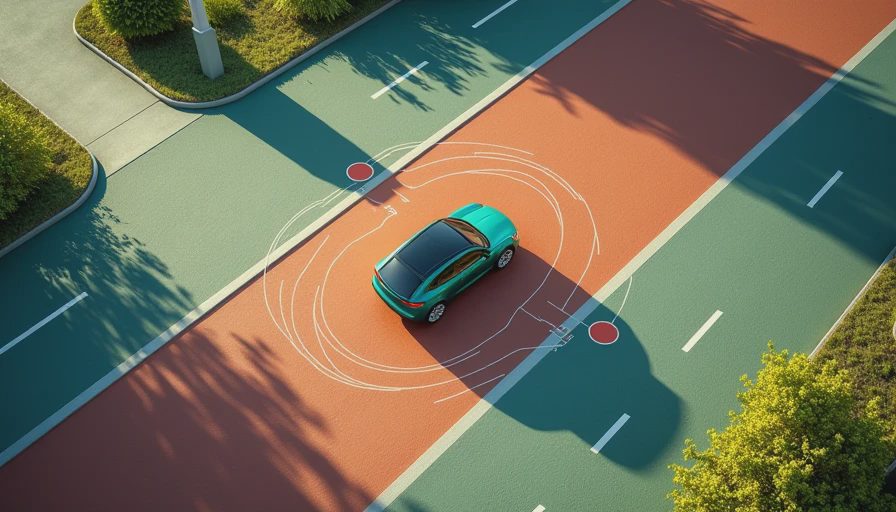
An over-the-air update can alter perception thresholds, planner preferences, driver monitoring, map behavior, or alert timing. The release note may mention smoother lane changes, but smoothness is not a complete metric. A system can feel calmer while becoming more conservative around merges. It can also reduce nuisance braking while increasing late reactions to stopped objects.
After an update, I repeat baseline scenarios before trying new ones. My minimum regression set includes a stopped vehicle, a pedestrian near the curb, a sharp unprotected turn, a lane split, a temporary speed sign, and a vehicle cutting in. I record software version and calibration state every time. If the weather changes, I label the result accordingly rather than pretending the runs are identical.
This is where autonomous autonomous becomes a useful reminder: repeated words should trigger repeated tests. One smooth drive proves almost nothing. Three inconsistent drives reveal a system boundary.
How drivers should interpret the label
Treat autonomous autonomous as a prompt to investigate, not as proof that a car drives itself. Read the owner documentation and identify the system's actual operating domain. Some features require divided highways, visible lane markings, a set speed, or an attentive driver. Others operate at lower speeds but stop when road geometry becomes unfamiliar.
Before relying on assistance, test it in a low-risk setting. Learn how to cancel steering, apply the brake, and resume manual control. Keep both hands available even if the vehicle permits hands-free operation. Do not use a phone, watch a video, or treat an attention reminder as an invitation to disengage.
For buyers, compare the boring details. Is driver monitoring camera-based? Does the system provide a clear takeover request? Are repairs to cameras and radar expensive after a windshield replacement or bumper impact? Does the manufacturer publish meaningful safety documentation, or only polished demonstration footage? A $300 monthly payment does not make an opaque system safer than a less flashy one with predictable limits.
The benchmark is the product
The best autonomous autonomous review is not a single verdict. It is a versioned record of scenarios, failures, recoveries, and unknowns. Engineers need raw traces and reproduction steps. Owners need plain language about when the feature works and when it becomes a liability. Both groups benefit from the same discipline: define the route, control the variables, log the intervention, and publish the miss.
My current conclusion is deliberately narrow. I have not proven that any production system is autonomous in the broad human sense. I have measured whether particular features perform particular tasks under particular conditions. That is less exciting than a launch event, but it is information a driver can use.
If you are evaluating a new vehicle, start with the scorecard rather than the slogan. Save the software version, run the same corner cases, and separate perception, planning, and controls in your notes. When the system does something strange, replay it before explaining it away. That is how a duplicated search phrase becomes a useful engineering question: what did the car do, and can we reproduce it?