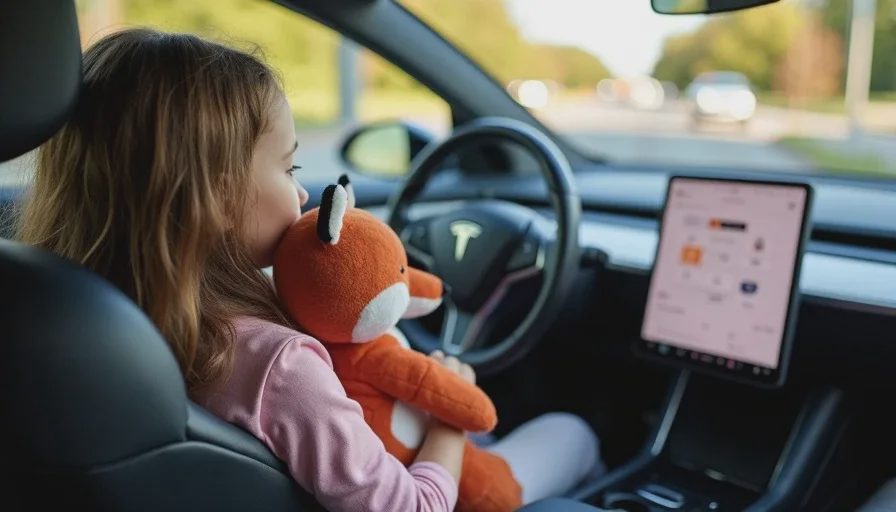
Maya is five years old. She cannot read a CAN bus trace. She doesn't know what a transformer is. She has never heard of end-to-end neural networks or trajectory optimization.
But she has strong opinions about robot drivers.
I've been testing autonomous vehicles since before she was born. She's been riding in them since she was a toddler. She doesn't know which system she's riding in—she just knows how it feels. And her feedback, distilled into five-year-old honesty, is often more useful than a thousand lines of log data.
Here's what she's taught me about the cars I test.
The Test Protocol (Maya's Edition)
I don't give Maya a questionnaire. I don't show her the scorecard. I just take her along on test runs, the same way I take her to the grocery store or the park. I listen to what she says—unprompted, unfiltered, and usually while she's playing with a stuffed fox in the back seat.
She's ridden in three autonomous-capable systems over the last two years: Tesla FSD, GM Super Cruise, and Ford BlueCruise. She doesn't know which is which. She just knows what she experiences.
Here's her verdict.
Tesla FSD: "It stops like it's scared, Dad."
The first time Maya rode in a Tesla with FSD engaged, she was three. She sat in her car seat, coloring, while I drove. The car approached a stop sign, decelerated smoothly, and came to a gentle stop. She didn't look up.
Then, at a green light, the car hesitated—a brief 0.8-second pause before accelerating. She looked up from her coloring book and said: "Dad, why is the car scared?"
I didn't have a good answer.
Since then, she's refined her critique. Every time the car brakes harder than necessary, or hesitates at a green light, or slows down for a shadow, she says the same thing: "It stops like it's scared, Dad."
She's not wrong.
I've measured the brake jerk on my test routes. The Tesla's deceleration profile is often aggressive—not emergency braking, but a higher-than-necessary rate of deceleration. It's the kind of braking that makes passengers uncomfortable. It's the kind of braking that feels like uncertainty.
Maya doesn't know about jerk or deceleration rates. She knows that the car brakes like someone who's not sure what's ahead. She knows it's scared.
Super Cruise: "It drives like a robot."
On a road trip to Chicago, we took the Cadillac Lyriq with Super Cruise. Maya was in the back seat, playing with her stuffed animals. The car was cruising in the right lane on I-94, maintaining speed, following lane markings.
At first, she didn't say anything. Then, after about 20 minutes, she said: "Dad, this car drives like a robot."
I asked her what she meant.
"It doesn't move right," she said. "It just stays in the middle. It doesn't go around the bumps. It doesn't steer like you do."
She had a point.
Super Cruise is a precise, lane-centering system. It keeps the car exactly in the middle of the lane, regardless of the road surface, the curvature, or the surrounding traffic. It doesn't adjust to the imperfections of the road. It doesn't find the smoothest line through a curve. It just… centers.
A human driver naturally tracks a slightly different line—sometimes left of center to give space to a truck on the right, sometimes right of center to avoid a pothole. The human driver's trajectory is adaptive. The robot's trajectory is rigid.
Maya felt the difference. She just didn't have the vocabulary to describe it.
BlueCruise: "It waits too long."
The Ford Mustang Mach-E with BlueCruise was Maya's least favorite. She sat in the back seat, frowning, as the car approached a merge on US-23.
"Why is it waiting?" she asked. "The other car is far away."
BlueCruise, in my test runs, is often overly cautious. It waits for a larger gap before merging, brakes earlier than necessary, and generally avoids any behavior that could be perceived as aggressive. It's safe, but it's frustrating—to me, and to Maya, who just wants to get to the playground.
She noticed the waiting. She noticed the hesitation. She didn't know it was a safety policy; she just knew the car was slow.
What Maya Sees That I Miss
Maya's observations are not a scientific measurement. They're subjective, inconsistent, and colored by her mood, her hunger, and whether she's had a nap.
But they are also honest. She doesn't have a professional bias. She doesn't know which system she's riding in. She doesn't read the release notes. She just experiences the car, and she tells me what she feels.
Here's what she's taught me about the gap between my metrics and her reality:
1. The jerk metric doesn't capture the feeling of "scared."
I measure jerk—the rate of change of acceleration. I report it in m/s³. It's a precise, objective metric.
But jerk doesn't capture the context. A car that brakes hard because it sees a pedestrian is braking hard for a good reason. A car that brakes hard because it's uncertain about a shadow is braking hard for a bad reason. The jerk metric is the same. The experience is different.
Maya feels the difference. She knows when the car is braking for a reason, and when it's braking because it's confused. She doesn't call it "confusion." She calls it "being scared."
2. The trajectory reasonableness score doesn't capture "robot-like."
I measure trajectory reasonableness: curvature continuity, safety margin, human likeness. It's a composite score that I've carefully calibrated.
But the score doesn't capture the feel of a trajectory. A trajectory can be safe, smooth, and physically reasonable, and still feel robotic—still feel like a machine is executing a plan, not a person is navigating a world.
Maya felt the roboticness. She noticed the lack of subtlety, the lack of adaptation, the lack of the small adjustments that make human driving feel natural.
3. The latency metric doesn't capture "waiting too long."
I measure latency—the time from input to trajectory output. It's a precise, objective number. I report it in milliseconds.
But latency doesn't capture the subjective experience of waiting. A 500-millisecond delay at a stop sign feels different from a 500-millisecond delay at a merge. At a stop sign, the delay is acceptable. At a merge, the delay is frustrating.
Maya felt the difference. She didn't know why the car was waiting. She just knew it was slow.
Why Children Are the Best Evaluators
Children are the ultimate usability testers. They have no preconceived notions. They have no understanding of the technology. They just experience the product, and they tell you what they feel.
Maya's feedback is not a replacement for my scorecard. It's a complement. The scorecard tells me what's safe. Maya tells me what's good.
A car that passes every safety metric but feels terrifying to a five-year-old is not a car I want my family riding in. A car that feels smooth, natural, and trustworthy—even if its metrics are not perfect—is a car I'll use.
Maya's standard is simple: "It drives like Dad." That's her benchmark. If the car drives like a robot, it's bad. If it drives like a human, it's good.
And she knows the difference.
The Data (Maya's Version)
I've started a separate logbook for Maya's observations. It's not on Airtable. It's a notebook in my garage, next to the Miata's logbook. It's full of her comments, her sketches, and her ratings.
Here are a few entries:
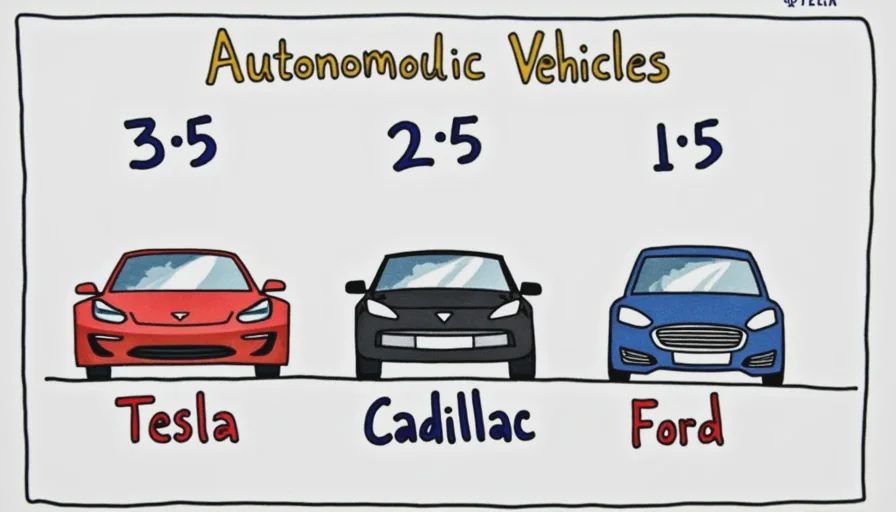
Tesla FSD (v12.5.1) — Maya's Rating: 3/5
"It stops like it's scared, Dad."
"The wheel moves too much." (Steering corrections)
"I like when it goes fast."
GM Super Cruise (v2.3) — Maya's Rating: 2/5
"It drives like a robot."
"It's boring."
"I don't like the beeping." (Driver attention alerts)
Ford BlueCruise (v1.5) — Maya's Rating: 1/5
"It waits too long."
"It's scary when it waits."
"I want to get there faster."
Drew in the Miata — Maya's Rating: 5/5
"You drive good, Dad."
"The car goes vroom."
"It doesn't beep."
The Bottom Line
Maya is not an engineer. She's a five-year-old who wants to get to the playground without being scared, bored, or frustrated.
Her feedback is simple. It's also important. The autonomous driving industry measures safety, but it rarely measures trust. It measures performance, but it rarely measures experience. It measures the system, but it rarely measures the passenger.
Maya measures the passenger. She measures how the car makes you feel. And her verdict is clear: the cars are safe, but they don't feel right. They're impressive, but they're not natural. They're capable, but they're not trustworthy.
The industry needs to listen to the five-year-olds. Because the five-year-olds are the ones who will grow up with these cars. They're the ones who will decide whether autonomous vehicles are a welcome part of their lives or a tolerated nuisance.
And right now, their verdict is: not good enough, Dad. Not yet.