July 29, 2026, 7:18 a.m., Ann Arbor, Michigan. The car approached a right turn with a clear lane, a parked delivery van, and a cyclist waiting well outside the vehicle path. It slowed twice, then began turning toward the van before correcting. That is why tesla fsd regression testing matters. An update can improve one scenario and quietly damage another. A smooth demonstration is not a release qualification plan.
I am not treating an over-the-air update as a personality change or grading it from a single neighborhood drive. I use the same routes, prompts, camera position, weather notes, and scoring rubric after each version. The goal is simple: reproduce the behavior, compare it with the previous build, and record the gap between a reasonable trajectory and the one the car actually chose.
What regression testing should measure
tesla fsd regression testing is not just counting interventions. A driver grabbing the wheel is important, but it is a lagging indicator. The car can make a poor decision without forcing an immediate takeover. I score lane selection, speed planning, yielding, gap acceptance, object handling, and recovery after an uncertain perception event.
Each event receives a severity rating from 1 to 5. A severity 1 issue is awkward but harmless, such as braking too early for an empty crosswalk. A 3 creates a meaningful comfort or safety concern, such as drifting toward a blocked lane before correcting. A 5 is an immediate conflict requiring intervention or creating a credible collision path. The number does not replace video and telemetry; it gives repeated observations a common scale.
I also record latency. Did the system recognize the stopped vehicle before the braking zone, or only after the lead car had already become unavoidable? Did the planner hesitate for one second or four? A vehicle that eventually chooses the right action can still have a regression if the timing leaves less usable margin.
Build a route set that can expose changes
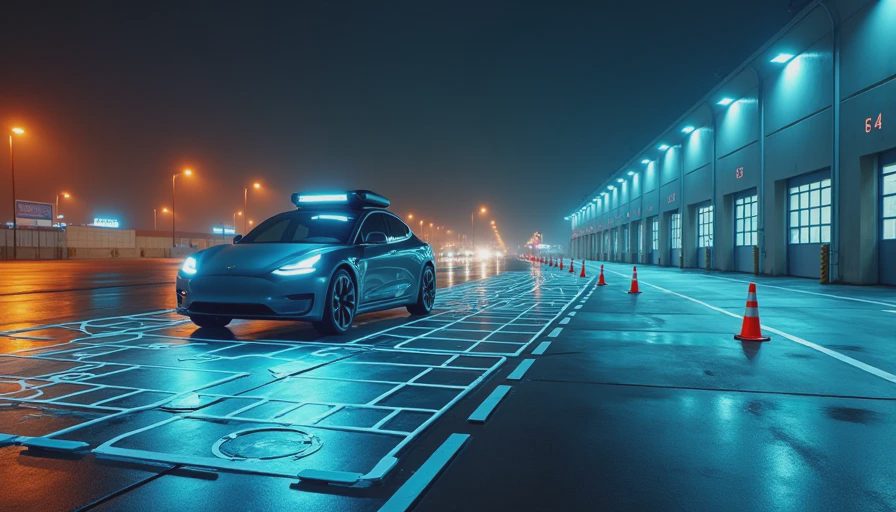
A useful route is not the prettiest route in town. It is a controlled question. My local set includes an unprotected left turn, a construction merge, a lane ending near a traffic signal, a narrow residential street with parked vehicles, a roundabout, and a road where tree shadows cross the lane markings. Each segment tests a different dependency in perception, prediction, or control.
For tesla fsd regression testing, I drive the same segment in both directions when practical. Sun angle changes the camera image. Traffic density changes the planner's available gaps. A route that looks stable at 9 a.m. can expose a different failure mode during afternoon glare. I log temperature, precipitation, road surface, traffic level, software version, and whether the route was manually interrupted.
The comparison run needs discipline. I do not rerun a scenario until the result looks favorable. I use a fixed attempt count, preserve the failed clip, and label every manual intervention with a timestamp. If the car takes a different line because a bus blocks the original lane, that is not automatically a regression. If it makes the same unreasonable choice under similar conditions, confidence in the finding rises.
The harness and the evidence
My harness is deliberately boring. A forward-facing recording captures the scene and driver controls. A second view captures the instrument display and hands. The run sheet stores software version, vehicle configuration, route ID, start time, weather, and intervention point. After the drive, I align the video with notes and classify the event before watching it repeatedly.
This is where tesla fsd regression testing benefits from the same habits used in machine-learning evaluation. Freeze the test set. Separate exploratory drives from benchmark drives. Do not delete an outlier because it complicates the chart. A three-run result that produces three different behaviors is not useless; it may indicate sensitivity to traffic context or an unstable decision boundary.
I keep raw clips, not just screenshots. A screenshot proves where the car was, but not what happened during the preceding five seconds. It cannot show whether the brake application was progressive, whether the turn signal appeared late, or whether the driver had already begun correcting. Those details often determine whether an event is a planner issue, a perception miss, or a control response that arrived too late.
How I compare an OTA release
Before installing an update, I run a baseline on at least the highest-value segments. After installation, I repeat those segments before exploring any new capability. The first pass checks obvious behavior: speed control, lane centering, turns, merges, and stops. The second pass targets known historical failures. The third pass investigates anything that changed unexpectedly.
For tesla fsd regression testing, I compare more than pass or fail. A table might show that version A produced two severity 2 events and one severity 4 event across ten benchmark segments, while version B produced four severity 2 events and no severity 4 event. That is an improvement in one dimension and a possible comfort regression in another. Reducing serious conflicts matters, but masking every uncertainty with excessive braking is not a free win.
I also separate capability from confidence. If construction cones are detected correctly on three runs but the vehicle chooses different paths each time, the perception result may be good while planning remains inconsistent. Conversely, a clean trajectory can conceal a perception shortcut that fails when the scene changes slightly. The log needs enough detail to distinguish those cases.
A sample finding from the log
Here is the format I use. The car entered a right-turn lane behind a box truck, slowed below the surrounding traffic speed, and stayed beside the truck instead of completing the turn. It should have either followed the lane decisively or yielded behind the truck with a clear gap. The gap was an unnecessary lateral drift, followed by a late correction.
I marked that event severity 3, not because a collision occurred, but because the trajectory reduced predictable space near a large vehicle. I repeated the route twice. On the second run, the truck was absent and the behavior disappeared. On the third, a different van produced a shorter version of the same hesitation. That makes the finding weaker than a deterministic bug, but stronger than a one-off story. The likely trigger is vehicle occlusion combined with turn-lane geometry, not simply the presence of traffic.
This is the kind of result that gets lost in a polished drive video. The car finishes the maneuver, nobody is hurt, and the clip looks ordinary. The scorecard preserves the uncomfortable middle: technically completed, operationally questionable, and worth retesting after the next release.
What owners and engineers should publish
A useful report names the software version, vehicle configuration, route conditions, number of attempts, intervention policy, and severity rubric. It should include the failed clip and explain what the driver expected. Saying that an update feels better is not enough for another engineer to reproduce. Saying that it failed at a specific lane ending under a specific lighting condition gives the community something testable.
Owners should avoid turning one successful trip into a safety claim. Engineers should avoid dismissing a low-frequency event because it is hard to trigger. Both errors confuse anecdote with evidence. For tesla fsd regression testing, the practical standard is repeatability, transparent uncertainty, and a clear distinction between observed behavior and speculation about the underlying model.
My next run will revisit the delivery-van turn, the shadowed lane markings, and the construction merge. If the behavior improves, the old clip stays in the archive. If it worsens, I will not call the software broken from three drives. I will publish the conditions, the raw count, and the failure mode. Your car talks. I check his homework.