Apollo Go is one of the largest real-world robotaxi programs built by a Chinese technology company, Baidu. That sentence is useful context, not a performance score. A fleet operating in multiple cities proves deployment discipline. It does not, by itself, prove that the driving policy handles every awkward merge, unprotected left turn, or temporary lane shift correctly.
I have not treated Apollo Go as a magic black box or translated Baidu's announcements into test results. The practical question is narrower: what can an engineer, researcher, or serious ADAS owner actually infer from the available evidence? Here's what happened. Apollo Go operates a geofenced autonomous ride service. Here's what it should do. It should produce safe, predictable trajectories inside that operating domain. Here's the gap. Public fleet scale tells us less about edge-case behavior than a reproducible log does.
What Apollo Go actually is
Apollo Go is Baidu's robotaxi service, built on the company's broader Apollo autonomous-driving platform. The service has operated in selected areas rather than attempting unrestricted, everywhere autonomy. That distinction matters. A geofenced system can use high-definition maps, carefully selected roads, remote assistance, fleet monitoring, and operating rules that reduce the problem before the vehicle moves.
That is not a criticism. Every production autonomy stack needs an operational design domain, or ODD. The engineering achievement is making the complete system work reliably within its ODD, including sensors, localization, prediction, planning, controls, cloud services, maintenance, and passenger support. The mistake is assuming that success in one bounded district transfers automatically to a snow-covered arterial in Michigan or an unprotected turn in an unfamiliar suburb.
When reading about Apollo Go, I separate three layers. The first is the vehicle's driving policy: perception, prediction, planning, and control. The second is the service layer: dispatch, remote support, cleaning, charging, and incident response. The third is the business layer: fares, utilization, regulatory permission, and fleet economics. A press release can describe the third layer while readers assume it measured the first.
The test harness I would use
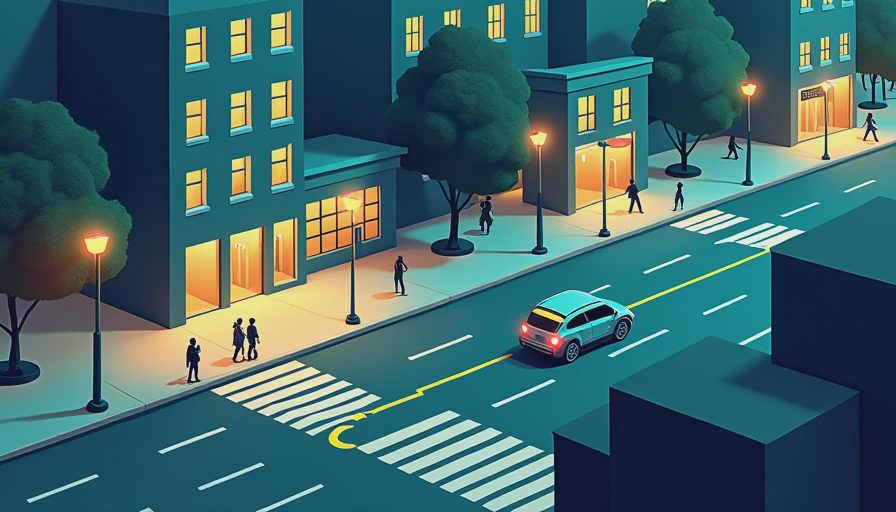
My Apollo Go evaluation would begin with a route definition, not a ride video. I would record the city, road class, weather, lighting, traffic density, construction status, safety-driver or remote-assistance configuration, and whether the passenger could influence the route. Without those controls, two rides are anecdotes, not comparable trials.
The core scorecard would track intervention-equivalent events, even when no human driver is physically present. A severity-1 event is cosmetic or mildly awkward: unnecessary hesitation, an overly wide stop, or a cautious but harmless response. Severity 2 is a clear planning inefficiency, such as blocking a driveway or stopping too far from a pickup point. Severity 3 forces another road user to accommodate the vehicle. Severity 4 creates a credible collision path or an unsafe lane commitment. Severity 5 is an actual collision or an immediate life-threatening failure.
I would also measure arrival accuracy, minimum time-to-collision in selected scenarios, time spent stopped without a clear reason, route replanning frequency, and how often the vehicle requests help. Those measurements need synchronized video, vehicle telemetry, and a scene timeline. A phone camera alone cannot tell us whether the car saw a pedestrian, predicted a cyclist's path, or received a remote recommendation.
For Apollo Go, the most revealing tests would be repeated runs of the same maneuver. Try a delivery truck partially blocking a lane, a pedestrian standing near a crosswalk, a cyclist passing on the right, and a temporary cone taper. Run each scenario at least three times. If the behavior changes substantially, that variance belongs in the result rather than being dismissed as noise.
Where the system can look strong
A mature robotaxi service should perform well on repeated, mapped routes with clear lane markings, predictable traffic flow, and good sensor visibility. Those conditions let the stack exploit route familiarity and give its prediction models a manageable set of interactions. Consistent stopping behavior and conservative following distances are more valuable than a dramatic, human-like maneuver.
Apollo Go's strongest evidence is therefore operational consistency inside its declared service area, not a single impressive clip. If vehicles can complete thousands of ordinary passenger trips while maintaining safe fallback procedures, that demonstrates substantial systems engineering. It also suggests the service has solved unglamorous problems that demonstrations often hide: vehicle cleaning, charging schedules, fault monitoring, passenger verification, and dispatch recovery.
Still, consistency needs a denominator. “Thousands of rides” is not enough unless we know trip length, weather distribution, disengagement criteria, minor contact events, remote interventions, and exposure to difficult scenarios. A fleet can accumulate impressive mileage while avoiding the exact cases that matter most. This is why my benchmark treats coverage as a first-class metric.
The corner cases I would not hand-wave
The first difficult category is temporary geometry. Construction zones change lane boundaries, remove curb space, and create human-directed traffic. A map-dependent vehicle may understand the planned road but struggle with the road that exists today. The second is social negotiation: a double-parked car, a driver waving another vehicle through, or a pedestrian who enters the roadway without committing to a crosswalk.
The third is pickup and drop-off behavior. These interactions look simple until the curb is occupied, the passenger is standing on the opposite side, or stopping legally would require a short walk. A robotaxi that reaches the destination but blocks a bike lane or stops in moving traffic has completed navigation while failing the service task.
The fourth is degraded sensing. Rain, glare, darkness, spray, dirty lenses, and occlusion can change the confidence of every downstream module. I would want Apollo Go results separated by weather and light, not averaged into one reassuring fleet number. If the available evidence does not include those slices, the honest rating is unknown, not excellent.
What US readers should take from it
Apollo Go is not a consumer product that a typical US driver can simply order in most cities. Its value for US engineers is as a deployment case study: how a company defines an ODD, manages a fleet, integrates remote assistance, and turns mapped geography into a repeatable service. Its value for vehicle owners is more limited. A robotaxi trip does not validate the lane-centering or supervised-driving system in a privately owned car.
That distinction prevents a common category error. Apollo Go may use a sensor stack, compute platform, and autonomy architecture unlike those in a Tesla, Ford, Mercedes-Benz, or vehicle running openpilot. Results cannot be transferred by brand association. The correct comparison is behavior under matched scenarios, with matched definitions of intervention and failure.
For anyone considering an autonomous ride, I would ask who is responsible when the vehicle stops, how a passenger contacts support, what happens during a system fault, and whether the service publishes safety or disengagement information. Those are boring questions. Boring questions are where real autonomy lives.
Bottom line from the garage
Apollo Go deserves attention because operating a robotaxi fleet is harder than producing a polished demonstration. It also deserves skepticism because deployment scale is not the same thing as general intelligence on the road. My current conclusion is deliberately narrow: Apollo Go is meaningful evidence of bounded operational competence, but public information alone is insufficient to assign a trustworthy edge-case safety score.
The next useful test is not another highlight reel. It is a fixed route set, repeated across weather and traffic conditions, with raw event logs and a clear severity rubric. Until that data is available, I will record claims separately from observations and mark unanswered questions as unanswered. Your car talks. I check his homework.