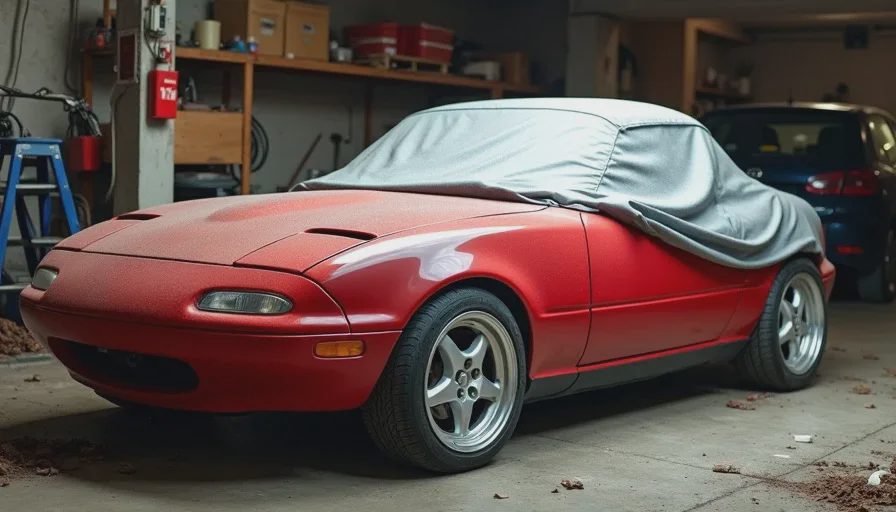
The Miata sits in the garage under a car cover. It's not a show car—it's a 2016 ND1 with 47,000 miles, a set of coilovers, sticky tires, and no aero. It's loud, it's small, and it's the most honest piece of machinery I own.
It's also my control group.
I test autonomous driving models professionally. I spend my weekends measuring latency, hallucination rates, and trajectory reasonableness in production systems. I build test harnesses and collect data. I run the scorecard after every OTA.
But the Miata is the only car I trust without data.
Here's why I keep an analog, manual, unassisted-by-software car in my garage, and what driving it at the limit has taught me about the decisions autonomous models make at 35 MPH in traffic.
The Baseline Hypothesis
Before I started this project, I had a hypothesis: there's a gap between how a driving model performs and how a human driver feels. And that gap is visible in the data—if you know what to look for.
The industry measures performance. It tracks disengagement rates, collision avoidance, and time-to-collision metrics. These are objective measurements, and they're necessary for safety certification.
But the industry doesn't track feel. It doesn't track how the car communicates its intentions to the driver. It doesn't track whether the car's decisions are predictable in a fluid, uncertain environment. And it certainly doesn't track whether the car's behavior is consistent with the car's own understanding of its capabilities—what I call "honesty."
A car that brakes hard is performing. A car that brakes hard only when necessary, and communicates that decision through the steering wheel and the pedal, is driving well.
The Miata is my reference for "driving well."
What the Miata Teaches Me
The Miata doesn't have lane-keeping assist. It doesn't have adaptive cruise control. It doesn't have autonomous emergency braking. It's just a steering wheel, a clutch, a throttle, and a chassis.
And it's beautiful.
Steering feel: The ND's electric power steering is light but communicative. I feel every imperfection in the pavement through the rim. I can tell when the front tires are approaching the limit of grip—not through a warning light, but through the weight and the vibration. This is not a luxury; it's a diagnostic system. The car is telling me what it knows.
Brake feel: The brakes are linear. The first 10% of pedal travel gives me 10% of brake torque. The next 10% gives me 20%. It's progressive and predictable. No artificial brake boost. No regen blending. I know exactly how much stopping distance I have at any given moment, because the pedal is a direct reflection of the hydraulic pressure.
Throttle response: The throttle cable is a direct link between my foot and the intake. No delay. No software smoothing. What I ask for is what I get.
Chassis communication: When the car understeers, I feel the front suspension loading through the steering wheel. When it oversteers, I feel the rear stepping out through the seat. The car doesn't hide information from me. It doesn't protect me from the consequences of my inputs. It tells me what's happening, and it trusts me to respond.
This isn't nostalgia. It's a control system.
The key insight: the car has a state. It knows its grip limit. It knows its brake temperature. It knows its suspension geometry. And it communicates that state to the driver, continuously, through the mechanical feedback.
Autonomous models don't have that. They don't communicate. They make decisions in a black box and execute them silently.
Driving at the Limit vs. Driving in Traffic
At the track, I drive the Miata at the limit. Not often—I'm not a professional—but often enough to understand the edge. When the tires start to slide, when the weight transfers, when the brakes fade, I'm in the same physical envelope that a driving model would interpret as an emergency.
Here's what I've learned:
1. The limit is not a line; it's a region.
The tires don't lose grip all at once. They transition from full grip to partial grip to slide over a range of forces. At the track, I can feel that transition. I can steer, throttle, and brake to stay inside the region where the tires are happy.
A driving model has no "feel." It has a confidence threshold. If the confidence crosses a line, it triggers a safety response—braking, swerving, stopping. The threshold is hard-coded. It doesn't adapt to the tire temperature or the road surface or the driver's intent. It just triggers.
2. Smoothness matters, not speed.
At the track, the fastest drivers are the smoothest ones. The drivers who don't saw at the wheel, who don't stomp on the brakes, who don't suddenly lift off the throttle—they're the ones carrying the most speed through the corner. It's a counterintuitive lesson: aggression destroys grip.
In autonomous driving, the model has no smoothness instinct. It has no understanding of chassis dynamics. It treats every deceleration request as a target, and it tries to achieve that target with maximum allowable braking force. The result is jerky, uncomfortable, and often unsafe.
3. Prediction is a physical skill.
When I'm following another car on the track, I'm not just reacting to their brake lights. I'm anticipating their corner entry, their apex speed, their exit. I'm reading the chassis language—the compression of their suspension, the angle of their body roll, the line they're taking. The car ahead doesn't communicate through a data link, but it communicates through physics.
Autonomous models don't do that. They infer intent from the observed state—the brake lights, the turn signals, the path—but they don't feel the physics. They don't know what it means when a car's body rolls more than expected. They don't know what it feels like when a car understeers or oversteers.
4. The gap is biggest at 35 MPH.
In traffic, at 35 MPH, the stakes are lower but the context is richer. There are pedestrians, cyclists, turning vehicles, stopped traffic. The road surface changes. The lighting changes. And the autonomous model is making decisions based on a static map, a set of camera feeds, and a set of brittle rules.
The Miata, at 35 MPH, is telling me everything. The road texture through the steering wheel. The incline through the brake pressure. The approaching intersection through my peripheral vision. The driver ahead through the body language of their vehicle.
I'm building a mental model of the situation that the autonomous model can't replicate. And when the model makes a mistake—when it decides to brake for a shadow or swerve for a ghost lane—I see the difference between a system that has data and a system that has understanding.
How the Miata Shapes My Scorecard
The Miata influences every metric I run.
Trajectory reasonableness: When I evaluate a model's trajectory, I ask: "Would this feel right in the Miata?" If the answer is no, I dig deeper. I've caught two hallucinations in the 2026 model year because the trajectory was perfectly safe on paper but would have felt jittery and unstable in a manual car.
Responsiveness: I measure how quickly the model reacts to new information. But I also note whether the response is proportional. A model that brakes hard for every input isn't responding safely; it's overreacting. The Miata's brake pedal has a proportional response. I want the same from the model.
Human likeness: I use a classifier to compare trajectories against human driving data. But I also do a subjective sanity check. "Does this trajectory look like something I'd do in the Miata?" That's not a formal metric, but it's a useful heuristic. If a trajectory looks robotic, it probably is.
Transparency: The Miata communicates its state through mechanical feedback. Autonomous models communicate through… nothing. I've started adding a metric to my scorecard: intent communication. Does the model signal its intentions? Does it telegraph its decisions? Does it give the driver time to anticipate? This is a metric that doesn't exist in the industry yet. I'm building it.
The Human Element
My daughter Maya, five years old, has strong opinions about cars.
She's been in the Miata dozens of times. She knows what it feels like to accelerate smoothly, brake gently, and corner without drama. She knows the sound of the engine, the shift of the weight, the way the car responds to the road.
When I let her sit in a test vehicle—an FSD-equipped Tesla, a Super Cruise-enabled Cadillac—she's quiet at first. Then she says: "It drives like a robot, Dad."
She's not wrong.
The autonomous model is a robot. It doesn't have feel. It doesn't have trust. It doesn't have the feedback loop that makes driving a manual car a conversation between the driver and the road.
But that doesn't mean the model is doomed. It means the model needs to be evaluated differently. It needs to be evaluated not just on its performance, but on its communication. On its predictability. On its feel.
The Miata is the benchmark for that evaluation. It's the car that doesn't have a single line of autonomous code, but somehow communicates more than any AI system I've ever tested.