November 2026, Ann Arbor, MI. I watched stacking waymo cars turn a clean curb lane into a slow-motion geometry test: one AV waiting behind another, a human driver easing toward the gap, and a pickup zone that stopped making sense. Here's what happened. Here's what it should have done. Here's the gap. On my scorecard, that is severity 3/5: not a crash, but enough confusion to matter if you care about downtime, liability, and the claim file that follows.
What stacking waymo cars looks like on the curb
On the ground, the pattern is usually boring before it gets annoying. The lead car is waiting for a rider, the next car arrives on the same curb point, and a third vehicle has no clean lane to use. That is how a simple curb stop turns into a queue. I have seen the same thing near airport pickup lanes, hotel loops, and narrow city curbs where the map says there is room but the paint says otherwise.
The engineering problem is not just spacing. It is how the planner handles uncertainty when the car is already in a constrained spot. If the route keeps sending vehicles to the same curb node, dispatch needs a new rule. If the system waits too long to claim a better slot, the queue grows. You can read all of that in dwell time, lateral offset, and the amount of time another driver has to sit and guess.
Why stacking waymo cars matters for claims
For stacking waymo cars, this is where the insurance side stops being abstract. If a bumper tap happens while cars are nose-to-tail at the curb, the claim file will depend on who was stationary, who had right of way, and what the logs show in the 30 seconds before contact. A low-speed rear-end can still become a $1,500 to $4,000 repair once you add a bumper cover, radar bracket, and calibration.
That is why commercial auto carriers care about frequency, not just severity. More dwell time in a messy curb zone means more chances for a cyclist, delivery van, or impatient commuter to interact badly with the vehicle. Personal lines shops like GEICO, Progressive, and State Farm know how to price a family sedan. A commercial or AV-adjacent account usually needs a broker who can read telematics, software version history, and the actual operating domain.
How I score stacking waymo cars in a test harness
My harness is simple on purpose. I log queue length, dwell time, path smoothness, stop-and-go count, and any time the vehicle leaves the expected curb envelope. If the car stacks neatly but clears the lane quickly, I call that severity 1 or 2. If it blocks the curb long enough to force another vehicle into a bad merge, that is a 3. If it creates a contact risk or near miss, it jumps to 4.
The useful part is comparison. I rerun the same loop after every software update and look for the same three things: shorter queues, cleaner gap acceptance, and fewer bad curb commitments. A model can look polished in a demo and still behave worse in a live pickup lane. If the timestamps say the new build sits 12 seconds longer than the old one, I do not care how pretty the UI looks.
A short curb-lane example
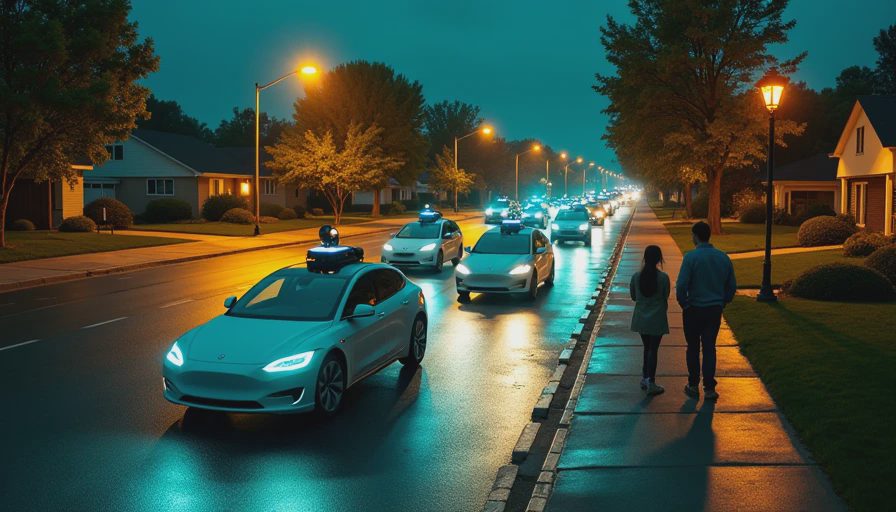
One short case from the log: a curb loop with room for one car and a waiting space across a painted line. The first vehicle arrived cleanly. The second one followed the same route and sat just far enough behind to keep a cyclist from passing. The third vehicle arrived on time but had nowhere sensible to go. No contact happened, but the lane was blocked long enough for a human driver to brake hard and glance over a shoulder. Severity 3/5, because the risk was in the geometry, not the headline.
How operators can lower the risk without guessing
The fix is usually not magical. Better curb maps, more honest staging rules, and tighter dispatch spacing solve a lot of it. If the system knows a pickup zone cannot take three cars, stop sending three cars. If the local lane is narrow, the routing layer should prefer a different curb or a different arrival window. Small changes in geofencing and queue management can reduce contact risk faster than a fancy perception model can.
This is also where telematics and video matter. A fleet with clean logs, dashboard footage, and software version history is easier to insure than one that can only say the car did something odd. In the personal auto market, the big carriers are built around standardized risk. In a commercial or AV setup, you want a carrier or broker that can read the operating data and not panic at it.
What to ask before you bind coverage
If stacking waymo cars shows up in your operation, ask for coverage that matches the real exposure, not the brochure. Liability limits matter first, because the ugly loss is usually the one where a low-speed incident turns into a bodily injury claim. Then look at collision and comprehensive, deductible structure, and whether sensor replacement or calibration is treated cleanly in the claim process.
For fleets, business interruption and downtime cost can matter almost as much as the sheet metal. A good underwriter will want the same thing I want from a driving model: the raw event, the context around it, and the proof that the behavior was either acceptable or fixable. If the answer is vague, keep shopping. Your car talks. I check his homework.