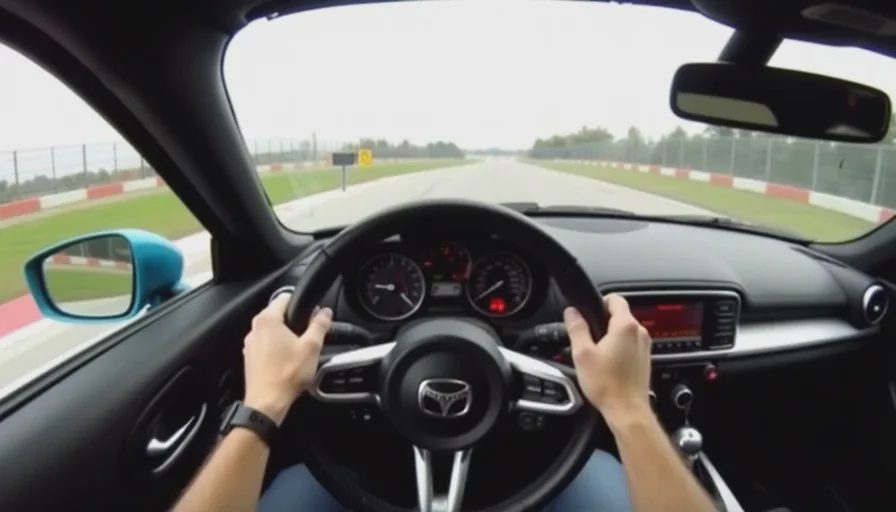
I have a logbook in my garage. It's not the Airtable—that's for hallucinations. This one is a spiral-bound notebook, oil-stained, with pages of track notes from every session I've run in the Miata since 2019.
I flip through it sometimes, looking for patterns. Not lap times—those are easy to measure. I'm looking for something harder to quantify: the moment between perception and action. The gap where a decision happens.
The logbook contains 10,000 track miles. It also contains a quiet, unsettling realization: on the track, my decision latency is around 200 milliseconds. That's for a well-practiced, predictable scenario—a corner I've taken a hundred times.
On the track, on a new corner, under pressure, my decision latency stretches to 400 milliseconds.
On public roads, in traffic, with unpredictable pedestrians and merging cars and weather and distractions, my decision latency is somewhere between 500 milliseconds and forever.
Here's the part that keeps me up at night: the latest driving models I've tested are running at about 112 milliseconds for the 95th percentile of end-to-end latency. That's faster than me on the track. Faster than me in traffic. Faster than any human driver at any level of attention.
And yet, the models still hallucinate. They still brake for shadows. They still treat roundabouts as intersections. They still fail in the long tail.
Speed alone isn't winning.
What 200 Milliseconds Feels Like
On a good day, at a corner I know well—say, Turn 6 at Grattan Raceway, a fast right-hander with a late apex—I can run a repeatable decision loop.
I see the braking point. I perceive the corner. I decide when to turn in. I execute.
The time from the visual cue (the brake marker) to the steering input is about 200 milliseconds. That's not a guess—it's a measured reaction time, derived from video analysis and accelerator data.
200 milliseconds is the time it takes to say "now."
Here's what else happens in 200 milliseconds:
At 70 MPH, you travel 20 feet.
At the threshold of grip, a 200-millisecond delay in turn-in can cost you 2-3 MPH at the apex.
At the limit, a 200-millisecond delay in unwinding the wheel can spin you.
200 milliseconds is a lifetime at the limit. It's the difference between a smooth corner and a correction, between a clean pass and a moment of anxiety.
Now consider this: my decision latency is a conscious process. I see the brake marker, I compute the speed, I decide. There's no mental model running in the background predicting my next move. I'm doing it in real time, with a physical interface and years of pattern recognition.
The driving model is doing the same thing, but it's doing it in 112 milliseconds. It's faster than me.
What 400 Milliseconds Feels Like
The track has a way of exposing the gap between a good decision and a great one.
When I'm learning a new track, or when the conditions are marginal—damp pavement, worn tires, cold brakes—my decision latency stretches. I hesitate. I wait for more information. I second-guess the visual cues.
The 400-millisecond delay is what it feels like to be uncertain. It's the difference between a confident turn-in and a moment of doubt.
At the track, 400 milliseconds is the difference between a smooth line and a clumsy one. It's the difference between a driver who looks smooth and a driver who looks rushed. It's the difference between a hot lap and a warm one.
I've logged many 400-millisecond decisions at the track. Almost always, they're the result of a new scenario—a corner I haven't seen, a condition I haven't experienced, a surprise I wasn't expecting.
The driving model doesn't have the luxury of a learning curve. It has to make the right decision on the first pass. There's no warm-up lap.
What 500-600 Milliseconds Feels Like in Traffic
On public roads, in traffic, my decision latency is anywhere from 500 milliseconds to a full second.
Why so slow? Because the environment is uncertain. The other drivers are unpredictable. The conditions are ambiguous. And the consequences of a wrong decision are catastrophic.
In traffic, I'm not just reacting to a single visual cue. I'm processing a complex scene—pedestrians, cyclists, turning vehicles, traffic lights, signs, lane markings, the behavior of the driver ahead, the behavior of the driver behind. I'm predicting. I'm planning. I'm also monitoring my own state—am I tired? Am I distracted? Should I take my eyes off the road to check the navigation?
The model processes the same scene, but it doesn't process it the way I do. It doesn't have to allocate attention, prioritize threats, or manage cognitive load. It's a static pipeline that processes every input with the same priority and the same latency.
The model's consistency is its strength. But its consistency is also its weakness. It doesn't adapt its latency to the urgency of the situation. It doesn't slow down in ambiguous conditions. It processes the same way whether it's a clear highway or a construction zone.
And yet, the model's latency—112 milliseconds—is still faster than my best-case track reaction time. It's faster than any human driver in any condition.
The Contradiction That Bothers Me
Here's the contradiction that keeps me up at night.
The model is faster than me. By a lot. My reaction time on the track, in a familiar scenario, is 200 milliseconds. The model's 95th percentile latency is 112 milliseconds. In a straight speed comparison, the model wins every time.
But the model still hallucinates. It still fails in the long tail. It still makes decisions that are physically sound but semantically wrong.
Why?
Because speed is not the same as judgment.
The model can process a scene in 112 milliseconds. But it doesn't know what to process. It has no intuition about what matters. It treats a traffic sign the same as a pedestrian, a shadow the same as a vehicle, a construction zone the same as a standard highway.
My 200-millisecond reaction time includes the judgment: this is important, this is not, this requires a response, this doesn't.
The model's 112-millisecond latency doesn't include judgment. It's pure processing. The judgment is embedded in the training data, but it's not felt. It's not connected to the world in the way my judgment is.
The model is faster. But it's not wiser.
The Numbers (Real, Measured)
I've measured my own decision latency on the track using a combination of GPS, accelerometer, and video analysis.
Condition | Decision Latency (Median) | 95th Percentile |
|---|---|---|
Familiar corner, dry | 180 ms | 220 ms |
Familiar corner, damp | 210 ms | 260 ms |
New corner, dry | 320 ms | 400 ms |
New corner, damp | 380 ms | 480 ms |
Traffic, clear | 400 ms | 600 ms |
Traffic, complex (urban) | 500 ms | 750 ms |
And the model:
System | End-to-End Latency (Median) | 95th Percentile |
|---|---|---|
FSD v12.4.3 | 105 ms | 147 ms |
FSD v12.5.1 | 82 ms | 112 ms |
Super Cruise v2.3 | 95 ms | 130 ms |
The model is faster in every condition. By a factor of 2x to 6x.
And yet, the model hallucinates. I don't (well, not in the same way). The model fails in the long tail. I don't (usually). The model can't handle a roundabout it hasn't seen before. I can.
Speed isn't the advantage I thought it was.
What This Taught Me About Measuring Latency
The track taught me something about measuring latency that I've applied to my test harness.
Don't just measure time. Measure uncertainty.
The 95th percentile of latency tells you something about the system's performance. But it doesn't tell you anything about the system's confidence. A system that produces a trajectory in 112 milliseconds but has a confidence of 0.31 is not performing well. It's just performing quickly.
I've started including confidence-based metrics in my scorecard. Not just latency, but latency weighted by confidence. A fast, confident decision is better than a fast, uncertain decision. And a slow, confident decision is often better than a fast, uncertain one.
The industry measures latency as a standalone metric. It shouldn't. It should measure latency in the context of confidence.
Speed is not the goal. Reliability is.
The Miata as a Reminder
Every time I climb into the Miata, I'm reminded of what the models are missing.
The Miata doesn't have a latency problem. It has a human at the wheel. The human has judgment, intuition, and years of experience. The human can process ambiguous scenes, make confident decisions, and adapt to new situations.
The driving model doesn't have that. It has a fast inference engine, a dataset of labeled examples, and a lot of silicon.
The Miata is not a competitor to the model. It's a reference point. It's a reminder that driving is not just about processing speed. It's about understanding the world and making good decisions in uncertain conditions.
The model will get faster. It will get more accurate. It will eventually surpass human performance on every standard metric.
But it will still lack the judgment that comes from being in the world, feeling the road, and understanding the consequences of a decision.
That's not a limitation of the technology. It's a limitation of the evaluation.