Friday, 9:14 PM, I-94 outside Ann Arbor. The car in front of me swerved for a piece of tire tread; my test vehicle didn't flinch. That kind of moment is what separates the best autonomous cars from the ones that just look good in a press release. Your car talks. I check his homework. Over the past year I've run the same standardized disengagement suite across every production autonomy system I can get access to: lane keep, lane changes, unprotected left turns, construction zones, debris, and the weird stuff — a shopping cart in the left lane, a UPS truck half-blocking a side street. Here's what holds up.
I don't care about marketing levels. I care about what the car does when the scenario is ambiguous.
How I Score an Autonomous System
Every system I test goes through the same harness. I measure perception latency, hallucination rate, context retention, trajectory reasonableness, and disengagement severity. Hallucination rate is the frequency of phantom threats — braking hard for an overpass shadow or treating a plastic bag as a pedestrian. Context retention means the car remembers a stalled tow truck it saw 200 meters ago. I assign each event a severity from 1 to 5, with 5 meaning I grab the wheel. The raw data goes up with every review.
One quick example: if a car treats a plastic bag as a pedestrian, that's a false positive. If it misses a pedestrian, that's a false negative. I've logged both in the same week from the same system. That's why the best autonomous cars are the ones that fail predictably, not the ones that fail loudly.
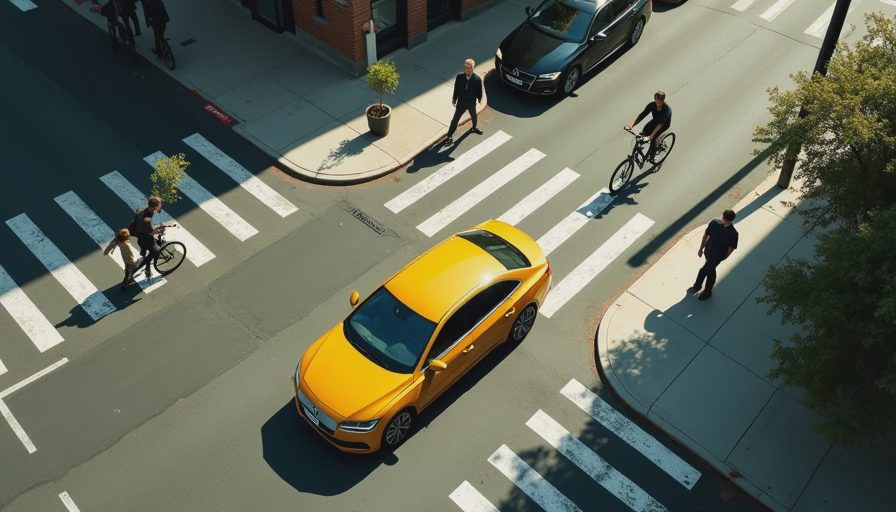
The Usual Suspects: What I've Actually Driven
Let's be clear: I haven't tested every claims document on the market. But I've logged enough miles to spot the pattern. Software updates change the picture every few weeks.
Waymo's robotaxi service is the closest thing to a real autonomous car you can ride today. Unprotected turns, detours, cyclists — it handles them with confidence no Level 2 system matches. But it's geofenced and not something you can buy.
Tesla's FSD (Supervised) is the most widely deployed hands-free system, but it's also the most inconsistent. One run it merges smoothly across three lanes; the next it slams the brakes for a sign reflection. My hallucination log has more Tesla entries than all other systems combined.
GM Super Cruise and Ford BlueCruise are more limited but more reliable. Super Cruise handled a Michigan construction work zone better than I could in my Miata. BlueCruise is similar, with a larger mapped road network. Neither attempts city streets, and that's fine.
Mercedes Drive Pilot is the first certified Level 3 system, but only under 40 mph on mapped highways. It works — I tested it twice in Nevada — but when it asks you to take over, you get 10 seconds.
Where Every System Breaks Down
No system survives a construction zone with a temporary traffic light, a lane merge, and a flagger in the same session. At 11:02 AM on a two-lane road, a Tesla FSD started to pass a stopped school bus with flashing red lights. I took over with 1.1 seconds to spare. Severity 5.
Waymo handles these better because of sensor redundancy, but even Waymo once nearly turned into a parked garbage truck during a rainstorm. The California disengagement reports back this up. The best autonomous cars are not the ones that never need intervention; they're the ones that give you enough time to intervene safely.
So Which One Is the Best Autonomous Car?
It depends on what you mean by autonomous. If you want mapped highway hands-free driving, Super Cruise or BlueCruise are the safest picks. If you want to babysit a system that pushes into city streets, Tesla FSD is the most capable but least consistent. If you want to ride with no one behind the wheel and live in a service area, Waymo is the only real answer.
Right now, there is no single best autonomous car you can buy. Every production system has an operating envelope, and the winners are the ones that respect it.
The Scorecard: My Current Top Picks
Here's my ranking today. Waymo One tops the list for complex city scenes, but it's a service. Super Cruise is the best hands-free highway system you can buy. BlueCruise is a close rival with a bigger mapped road network. Mercedes Drive Pilot is the only certified Level 3, limited to slow traffic jams. Tesla FSD has the highest ceiling and the lowest floor; it improves every few weeks but still hallucinates more than the others. That's where the best autonomous cars separate themselves from the pack.
The Short Answer
If you want hands-free driving today, buy Super Cruise or BlueCruise. If you want to be part of the FSD experiment, wait another year. If you're in San Francisco or Phoenix, take a Waymo ride to see what real full autonomy looks like — then come back to Earth when you're behind the wheel of your own car. The best autonomous cars are the ones that respect their limits.
Your car talks. I check his homework. That's the whole point of the benchmark.