At 7:42 a.m. on a wet Ann Arbor road, a driver-assistance system followed a painted lane toward a temporary construction barrier, then hesitated hard enough to trigger a warning. That is why best self driving cars deserve a test plan, not a marketing label. Here is what happened, what the system should have done, and the gap between those two outcomes.
The first correction is terminology. Most vehicles sold in the United States are not autonomous in the driverless sense. Tesla Full Self-Driving (Supervised), Ford BlueCruise, and General Motors Super Cruise are advanced driver-assistance systems. They can steer, brake, and accelerate in defined conditions, but the human remains responsible. Waymo operates a genuinely driverless service in limited areas, but that is different from buying a Waymo-equipped sedan at a dealership.
What “self-driving” means in a real car
A useful comparison starts with operational design domain, or ODD. That means the conditions a system is designed to handle: road type, speed, weather, lighting, map coverage, and driver-monitoring requirements. A vehicle that performs beautifully on a mapped divided highway is not automatically competent on an unmarked residential street in heavy snow.
For best self driving cars, I separate four capability layers. Adaptive cruise control manages speed and following distance. Lane centering controls lateral position. Hands-free highway assistance combines those functions with driver monitoring. Conditional or higher automation takes on more of the driving task, but availability remains tightly constrained by geography and weather.
That distinction matters for safety and insurance. A lane-centering system does not remove the driver’s duty to watch traffic. A collision involving a supervised system can still create ordinary liability questions, and comprehensive or collision coverage does not turn an assistance feature into a chauffeur. Read the owner’s manual and confirm how your insurer treats the vehicle’s equipment and repair costs.
My scorecard for best self driving cars
I do not rank a vehicle by the number of sensors, cameras, or processor cores. I rank the behavior produced by the complete stack. My repeatable scorecard gives separate scores from 1 to 5 for lane keeping, interaction with other road users, construction handling, unprotected turns, driver monitoring, recovery after a disengagement, and explanation quality.
A score of 1 means the system creates a serious hazard or fails to recognize its limits. A 3 means usable behavior with frequent supervision demands. A 5 means the system handles the test consistently and communicates a clear fallback. The score is not a probability of avoiding a crash; it is a structured observation of how the car behaved in a known scenario.
I also log latency. If a pedestrian steps from behind a parked vehicle, the important question is not whether the car eventually brakes. It is when perception changes, when the planner commits to braking, and how much road remains. I repeat each scenario because one clean run proves very little. Three runs that produce three different answers are not noise to hide; they are evidence of instability.
How current systems compare
Tesla’s Full Self-Driving (Supervised) covers a broad set of roads and can perform more visible maneuvers than ordinary highway assist, including turns and lane changes. Its weakness is that broad capability creates more opportunities for odd planning: unnecessary lane changes, cautious behavior around ambiguous objects, or a trajectory that looks legal but socially unreasonable. The driver must remain engaged.
GM Super Cruise is narrower but often easier to evaluate. Its hands-free operation depends on compatible roads, and its driver-monitoring camera checks attention. Ford BlueCruise follows a similar supervised highway strategy, with hands-free availability tied to designated road segments. These systems are not interchangeable: map coverage, lane behavior, re-engagement prompts, and weather limits differ by model year and software release.
Mercedes-Benz Drive Pilot is a more constrained example of conditional automation where available and approved. It is designed for specific traffic situations rather than general-purpose driving. That narrower promise can be a strength. Fewer supported scenarios give engineers fewer failure modes to manage, although they also give the owner less utility.
For best self driving cars, the practical winner depends on your route. A commuter who drives mapped interstates may value stable hands-free operation. Someone who spends every day on suburban arterials may prefer stronger conventional driver assistance and predictable alerts over a system with a larger feature list.
The edge cases that expose weak planning
The first test is construction. Temporary cones, shifted lanes, faded markings, and a worker holding a flag force the perception and planning stack to reconcile conflicting signals. The correct response is often slower and more conservative, not a dramatic swerve. I record whether the car recognizes the temporary lane, centers itself, and yields when a human directs traffic.
The second test is an unprotected left turn. A system can detect an approaching vehicle yet still misjudge its speed or leave too little margin. I watch for creeping behavior, abrupt cancellation, and whether the car commits only after a defensible gap appears. A smooth turn is not enough; it needs to be repeatable across lighting and traffic conditions.
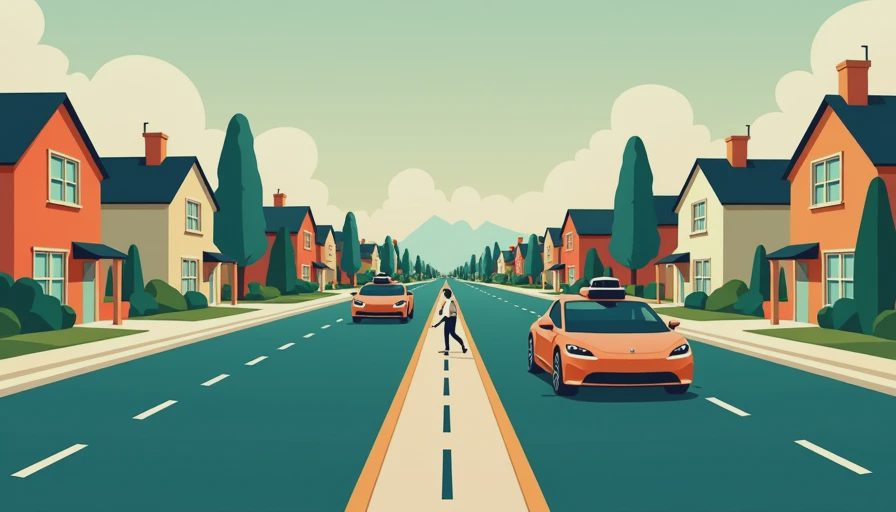
The third test is the stopped vehicle near a crosswalk. This catches systems that treat a blocked lane as a simple obstacle but fail to reason about a person hidden from view. The best self driving cars should slow early, preserve visibility, and avoid passing when the situation is ambiguous. A last-second brake is a failure even if the bumper stops short.
What to buy, and what to verify first
Start with the route, not the badge. Download or review the manufacturer’s compatible-road coverage where available. Ask whether hands-free operation works on your regular commute, whether the feature is included or subscription-based, and what happens during rain, snow, glare, or a dirty camera. A system that is unavailable for half your drive may be less useful than a simpler one that behaves consistently.
Then schedule a realistic test drive. Do not spend the entire appointment on a clean divided highway. Test a lane change, a merge, a tight curve, and a road with worn markings while keeping your hands and attention ready. Check how quickly the system asks for input and whether its alerts are audible, visual, and understandable.
The best self driving cars also need a repair and ownership check. Camera calibration after windshield replacement can add cost. Radar or bumper damage can disable assistance features. Ask for the deductible, parts policy, software subscription terms, and whether a temporary rental includes equivalent equipment. Those details matter more than a glossy launch video.
The answer is a measured recommendation
There is no universal winner in the best self driving cars category. Supervised highway systems currently offer the clearest everyday value for many owners, while broader systems offer more ambitious behavior and more visible edge cases. Driverless services demonstrate what tightly bounded autonomy can do, but they do not yet represent a normal private-car purchase.
My recommendation is simple: buy the system whose limits match your route, then judge it after repeated drives. Keep a log of disengagements, unexpected braking, lane changes, and weather failures. Compare software versions instead of relying on old reviews. If a vehicle makes a decision that does not make sense, record the timestamp and context rather than explaining it away.
Your car talks. I check his homework. The result is not a promise that autonomy is solved. It is a better buying decision, a safer mental model, and a testable answer to what “self-driving” actually means.