At 7:42 a.m. on a wet Tuesday in Ann Arbor, I watched a vehicle with lane-centering assistance drift toward a faded construction stripe, correct late, then brake for a shadow under an overpass. Nothing crashed. That is not the same as passing the test. Searches for cars with self driving usually combine several very different systems: adaptive cruise control, hands-on highway assistance, supervised automation, and genuinely driverless service. Those categories matter more than the badge on the trunk.
Your car talks. I check his homework. My test harness records steering input, braking, lane position, lead-vehicle distance, takeover alerts, and the exact road context. I score each event from 1 to 5. A 1 is an odd but harmless hesitation. A 3 requires immediate correction. A 5 is a collision, a missed hazard, or a system behavior that creates a credible path to one. This is not a manufacturer demo, and it is not a claim that any system drives itself everywhere.
What “self driving” means in a production car
Most cars advertised as cars with self driving are still Level 2 driver-assistance vehicles. The system can control speed and steering at the same time, but the human remains responsible for monitoring the road and intervening. General Motors Super Cruise, Ford BlueCruise, Tesla Autopilot and Full Self-Driving, Mercedes-Benz Drive Pilot in limited approved conditions, and systems built around openpilot do not all offer the same operating design domain.
That last phrase is the part people skip. An operating design domain defines where and when automation is intended to work: mapped divided highways, certain speeds, daylight, clear lane markings, or specific weather conditions. A system can be excellent inside its domain and useless outside it. Highway lane centering does not become city autonomy because a software update added a new menu item.
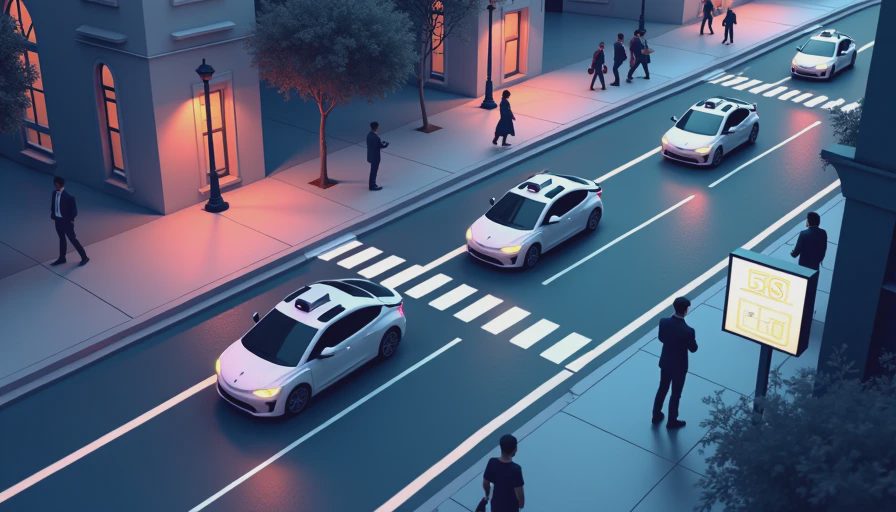
The control strategy also differs. Super Cruise and BlueCruise use driver-monitoring cameras and typically restrict hands-free operation to supported roads. Tesla puts more responsibility on the driver and has a broad feature set, but the name Full Self-Driving does not remove the requirement for active supervision. Waymo operates a different model entirely: its vehicles are designed for driverless service in selected geographic areas, not general retail ownership.
The test that breaks the marketing language
I separate capability from reliability. A system gets no credit for completing a route if it produces one dangerous decision along the way. My repeatable route includes a two-lane merge, a stopped vehicle partially hidden by a truck, a temporary lane shift, an unprotected left turn, a cyclist near the lane edge, and a road with worn markings. I run each scenario at least three times because a single clean run proves very little.
Here is one representative log format: “What happened: the car slowed abruptly beside a parked vehicle. What it should have done: maintain a predictable path while leaving a safe lateral margin. The gap: the planner treated the parked vehicle as a live-lane obstruction, then recovered only after the following driver closed distance.” That is a severity 3, not because the event looked dramatic, but because the recovery depended on traffic behind us.
Cars with self driving should be compared using this kind of behavior, not a list of cameras and processors. Hardware matters, but perception quality is only one component. Planning can misread intent. Controls can execute a reasonable trajectory too aggressively. Driver monitoring can technically detect an inattentive driver while still giving an alert too late to be useful. I want the raw event, the environmental conditions, and the software version.
Which systems are worth a closer look?
For frequent highway commuters, Super Cruise is a strong candidate to investigate because its hands-free operation is constrained by supported roads and a driver-facing camera. The constraint is a feature, not an embarrassment. BlueCruise follows a similar philosophy on compatible Ford and Lincoln vehicles, although behavior depends on vehicle hardware, road coverage, and software version.
Tesla offers a much wider range of automation features, but the wider envelope creates more opportunities to encounter ambiguous behavior. I have seen systems that handle a clean freeway interchange smoothly and then become indecisive around temporary markings. That does not make the entire product unsafe; it means the edge cases are part of the ownership decision. The driver still has to monitor continuously.
Mercedes-Benz Drive Pilot is a limited Level 3 example in specific conditions and jurisdictions, where the system can assume responsibility within its approved operating domain. That is materially different from Level 2 assistance, but it is not a universal robot chauffeur. Cars with self driving need a label that states the level, domain, fallback behavior, and driver obligation in plain language.
Insurance, repair cost, and ownership risk
Automation changes the insurance conversation without eliminating it. A vehicle with adaptive cruise, radar, cameras, and lidar can cost more to repair after a minor collision. A damaged windshield may require camera calibration. A bent radar bracket behind a bumper can turn a cosmetic repair into a larger claim. Depending on the vehicle and insurer, comprehensive and collision coverage can be especially important because sensor replacement is expensive.
Liability also remains complicated. In a typical Level 2 car, the driver is still responsible for supervision, so a failure to respond may be treated like a conventional driver error. A manufacturer’s marketing term does not automatically transfer fault to the company. Ask an insurer how advanced driver-assistance features affect premiums, repair procedures, glass coverage, and original-equipment-part requirements before buying.
When comparing cars with self driving, get insurance quotes for the exact trim, not just the model name. A basic vehicle with forward collision warning may price differently from a high trim with hands-free hardware. Request a repair estimate for a windshield, front radar sensor, and front camera calibration. Those three numbers tell you more about post-crash ownership than a glossy autonomy brochure.
A practical buying procedure
Start by writing the route you actually drive. If it is 90 percent interstate commuting, a mature highway-assistance system may be more useful than an ambitious city-driving package. If your route includes snow, construction, unmarked roads, and frequent urban turns, assume the system will hand control back often. That is not failure; it is the boundary you need to understand.
Next, test the vehicle in the same conditions you will face. Drive at dusk, in moderate rain, beside large trucks, and through a lane shift where legal and safe. Watch whether the car maintains a consistent gap, centers itself naturally, and communicates a takeover request early. Do not judge it solely by how confident the steering feels. Overconfidence is a bug when the perception stack is wrong.
Finally, verify the update policy. Ask whether key features require a subscription, whether maps affect availability, how driver monitoring works, and what happens when a camera is blocked. Save the software version and read release notes after updates. A change that improves smoothness can also alter braking timing or lane-change behavior.
The short version from the scorecard
The best cars with self driving are not necessarily the ones with the most dramatic names. They are the ones with a clearly defined operating domain, predictable fallback behavior, useful driver monitoring, and repair support that does not turn a small crash into a financial surprise. I would rather use a narrower system that knows where it belongs than a broader system that guesses.
Treat every demonstration as a hypothesis. Reproduce the scenario, record the conditions, and separate a clean run from a reliable one. If a sales representative says the vehicle can drive itself, ask where, at what speed, in what weather, and who is responsible when it cannot. Then get the insurance quote and the sensor-repair estimate.
The technology is useful. The vocabulary is often sloppy. Your job is to close that gap before handing over a down payment. Mine is to keep rerunning the test after the next over-the-air update.