A cold Ann Arbor morning, a construction barrel leaning into the lane, and a Tesla hesitating for half a second before committing. That is the kind of event that matters in an fsd v13 vs v12 comparison. Release notes can describe architecture, compute, and smoother behavior. They do not tell you whether the car will brake late for a cut-in, choose the wrong lane at a Michigan roundabout, or handle a delivery van blocking a turn.
This is not a spec-sheet victory lap. Tesla's FSD labels describe a moving software stack, and behavior depends on vehicle hardware, camera condition, calibration, region, traffic, and the exact build installed. A useful comparison therefore asks three questions: what changed, what can be reproduced, and which failures remain.
What the version numbers actually tell you
FSD v12 represented a major shift toward an end-to-end neural-network driving system. In plain English, more of the driving decision chain was learned from video and human driving data rather than assembled as a long list of hand-coded rules. That does not mean every component disappeared. Localization, vehicle control, safety constraints, mapping inputs, and driver monitoring still matter.
FSD v13 continued that direction while targeting broader capability and improved performance on newer Tesla hardware. Public descriptions have emphasized larger or more capable models and changes intended to support longer-range planning. Those statements are useful hypotheses, not proof of a better drive. A model can produce a more confident trajectory and still make a worse decision when a temporary lane marking conflicts with a familiar road pattern.
The main trap in an fsd v13 vs v12 comparison is treating the label as a controlled experiment. If the v12 drive happened in dry daylight and v13 ran in rain at dusk, the result is confounded before the first intersection. The same is true when comparing a newer vehicle computer with an older one.
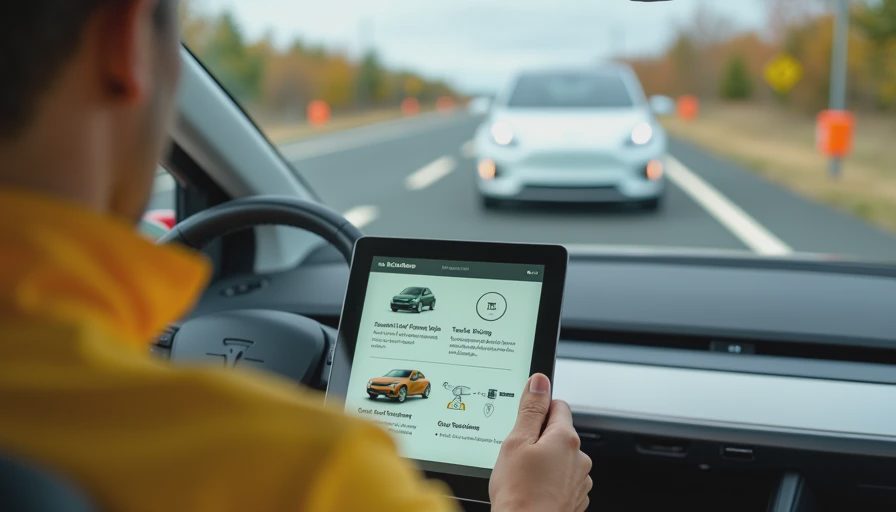
My test harness for the comparison
I score autonomous behavior like a bug tracker. Severity 1 is cosmetic or mildly awkward. Severity 2 is inefficient but predictable. Severity 3 requires driver intervention or creates a meaningful conflict. Severity 4 is an unsafe maneuver narrowly avoided by another road user or the safety driver. Severity 5 is an immediate collision-risk event.
For an fsd v13 vs v12 comparison, I would run the same route in both versions, preferably in the same vehicle and within a short time window. The route should include an unprotected left turn, a multilane merge, a double-parked vehicle, a stale green light, a protected turn with a confusing signal, and a lane closure. I record the timestamp, software build, weather, traffic density, intervention reason, minimum gap, and what a competent human driver would have done.
The minimum useful sample is not one dramatic video. It is repeated exposure to the same class of problem. Three runs that produce three different choices are not noise to delete; they are evidence that the policy is sensitive to context. I also separate intervention frequency from intervention severity. A system that asks for help twice to avoid a bad lane choice is not equivalent to one that asks once after drifting toward a curb.
Planning, lane choice, and hesitation
The most visible difference in an fsd v13 vs v12 comparison is often planning style. One build may begin a lane change earlier, hold a trajectory more decisively, or stop making the repeated nudges that drivers describe as “ping-pong.” Those are real usability improvements if they survive unusual geometry.
But earlier is not automatically better. On a freeway, an early lane change can be sensible when an exit is approaching. On a city street, moving early toward a turn lane can place the car beside a cyclist, a bus, or a row of parked vehicles. I care less about whether the car looks smooth in a clean YouTube clip and more about whether its predicted path remains reasonable when another agent changes the scene.
A practical test is to count plan revisions. If the vehicle signals, cancels, slows, and signals again because it cannot resolve a lane boundary, that is a planning failure even when the final maneuver is legal. Record the failed attempt, not just the completed turn. The abandoned plan is where the model's uncertainty becomes visible.
Edge cases that separate demos from driving
A serious fsd v13 vs v12 comparison needs adversarial but ordinary situations. Try a pedestrian stepping off the curb while a parked truck blocks the view. Try a vehicle turning left across the car's path without a clean lane boundary. Try roadwork where orange cones create a temporary channel that disagrees with the painted arrows. These are not exotic test-lab scenarios; they are the daily distribution tail.
I also test social negotiation. Does the car creep into a narrow gap because another driver waves it through? Does it yield forever when the priority is clear? Does it recognize that a vehicle stopped at a green light may be blocked, rather than treating the light alone as permission to proceed?
The correct record has three lines: here is what happened, here is what it should have done, and here is the gap. Add a severity score and a clip or timestamp. Without that structure, “v13 feels better” is an impression, not a result. With it, a regression can be reproduced and discussed by engineers instead of argued over by fans.
Hardware, weather, and rollout confounders
Software versions do not operate in a vacuum. Camera cleanliness, glare, rain droplets, low sun, and road contrast can change perception before planning gets a chance to work. Vehicle hardware also matters. Two Teslas receiving similarly named software can have different compute capability, camera generations, calibration histories, or feature availability.
That makes an fsd v13 vs v12 comparison incomplete unless the test log names the vehicle and hardware context. I would record model year, processor generation when known, tire condition, camera alerts, firmware build, and whether the car was running a supervised feature set with the same settings. Do not compare a restricted rollout build with a later general release and call the result a model comparison.
Rollouts are another source of false certainty. Early access software may be exposed to unusual routes and enthusiastic testers, while a later build may include silent fixes unrelated to the headline version. If the car behaves differently after a minor revision, log that revision. The version string is part of the evidence, not decoration.
What owners should measure before updating
Before an update, save five representative clips or written logs: a merge, an unprotected turn, a parking-lot interaction, a roadwork segment, and a route with a difficult lane split. Drive each segment twice if conditions allow. Note intervention count, hard braking, unnecessary stops, missed signals, lane position, and driver-monitoring prompts.
After updating, repeat the same route at a similar time. Avoid changing every variable at once. If a v13 drive is smoother but chooses a worse lane, write both facts down. If it completes more turns but requires a sharper braking correction, that tradeoff matters more than a general feeling of confidence.
In my fsd v13 vs v12 comparison, the winning release is not the one with the best demonstration. It is the one with fewer high-severity failures, more stable decisions across reruns, and clearer recovery when its first plan is wrong. Owners should update for a measurable improvement, not because a version number sounds newer.
The short verdict
The useful conclusion from an fsd v13 vs v12 comparison is conditional. V13 may represent meaningful progress in model scale, planning horizon, and driving smoothness, but those gains must be tested against construction, occlusion, ambiguous priority, and poor weather. V12 can still appear better on a familiar route when its behavior is more conservative or when the newer build is encountering different scenarios.
Your car talks. I check his homework. Keep the raw logs, repeat the same tests, and rate the failure rather than the confidence of the narration. Until a release survives that process, “better” is a claim waiting for a test.