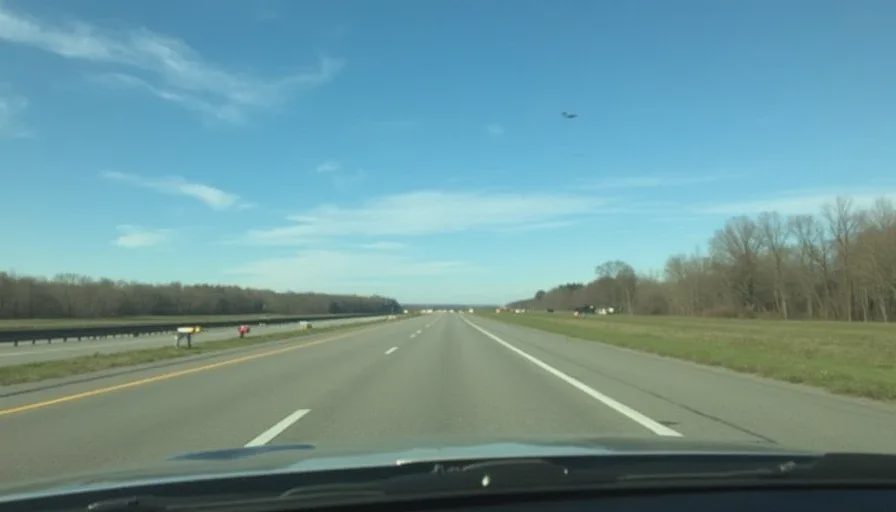
Here's the thing about phantom braking that no one tells you: it's not the braking that scares you. It's the moment before the braking, when you see a perfect, empty highway ahead, feel the car's confidence radiating through the steering wheel, and then—without warning, without reason—the car decides it's about to die.
I've logged 247 hallucinations since 2021. This one is #102.
It's also the one I'll never forget.
The Driver's Seat
June 18. 9:42 AM. US-23 northbound, just past the Brighton exit. I was on my way to a track day at Grattan Raceway—Miata on a trailer behind me, coffee in the cupholder, podcast playing at low volume. Empty highway. Three lanes. Not a single car within 200 meters in any direction.
Clear sky. No clouds. Sun at my 10 o'clock, low enough to cast long shadows but not low enough to glare. Temperature: 72°F. Humidity: 52%. Perfect conditions. Boring conditions.
The car had been cruising at 70 MPH for the last six miles. Autosteer engaged. No nags. No warnings. The visualization on the screen showed a clean road ahead, lane lines clearly delineated, no obstacles, no pedestrians, no bikes. The ghost of a semi-truck visible half a mile ahead on the adjacent lane, slowly being overtaken.
Then, at 09:42:18.3, the brake pedal dropped.
Not a tap. Not a gentle deceleration. The pedal went to about 60% travel in under 200 milliseconds. I know this because the CAN log says so. What the CAN log doesn't capture is the feeling: my body lurching against the seatbelt, the coffee cup launching out of the cupholder, the trailer hitch behind me groaning as the Miata's tie-down straps took the full shock of deceleration.
The car decelerated from 70 MPH to 45 MPH in 2.1 seconds.
That's 0.58 G of braking force. For context, that's about 70% of what a competent panic stop looks like. It's not emergency braking—no ABS activation, no seatbelt pretensioning—but it's well beyond comfort braking. It's "something bad is about to happen" braking.
The semi-truck that was half a mile ahead? I wasn't going to rear-end it. I wasn't even going to catch it for another 12 seconds. There was no obstacle. There was no pedestrian. There was no shadow. There was no bridge shadow. There was no pothole. There was no construction zone. There was just a clean, empty, well-marked highway and a car that was absolutely convinced it was about to hit something.
The safety systems didn't intervene because the car was the safety system. The car was panic-braking itself.
I pressed the accelerator. The car resumed speed. The event was over in 2.3 seconds.
Then I pulled over, sat in the shoulder for five minutes, and replayed the data in my head before I even touched the log files. I'd experienced phantom braking before—minor ones, 5-10 MPH taps that were more annoying than dangerous.
This was different. This was the car trying to stop itself from hitting a ghost.
What the Model's Output Logs Showed
An hour later, back home, I pulled the log files off the rig. The FLIR cameras had captured the entire sequence.
Here's the thing that jumped out: at exactly frame 1043, the model's perception module had downgraded a distant object from "CAR" (confidence 0.47) to "UNKNOWN" (confidence 0.31) with a secondary classification of "PEDESTRIAN" (0.22). That's a 0.31 confidence that a static object on the side of the road might be a pedestrian. Not strong. Not decisive. But apparently strong enough to trigger the planner's worst-case safety envelope.
The planner output at the same timestamp:
A 1.8-second TTC calculation is what you see when a child runs into the road, not when a static object sits on the shoulder at 88 meters. The planner had hallucinated urgency—it had misinterpreted the perception module's uncertain classification as a high-confidence threat and locked into a safety-critical response.
The 1.8-second TTC number doesn't make sense with a 0.31 confidence. The planner was treating a 31% uncertain classification as if it was 100% certain. That's a policy problem, not a perception problem. The model was, in effect, saying:
"At 31% chance this is a pedestrian, I'm going to brake like it's certain."
The downstream effect on the driving policy was catastrophic: the car had traded false-negative risk (not braking when it should) for false-positive risk (braking when it shouldn't) but the trade-off was so extreme that it effectively broke the system's ability to drive smoothly under normal conditions.
Why "False Positive" Doesn't Capture the Experience
The industry calls phantom braking a "false positive." A perception system falsely classifies an object as a threat. It's a technical term. It's precise. It's also grossly inadequate.
"False positive" sounds like a 5% increase in your spam filter's error rate. It sounds like a minor annoyance. It sounds like something that can be fixed with a software patch and maybe a quick email blast to owners.
What it doesn't describe is:
The physiological response: Your heart rate spikes to 120 BPM. Your muscles tense in anticipation of impact. Your brain, for 200 milliseconds, genuinely believes you are about to crash. This isn't anxiety. This is your nervous system reacting to a sudden, unexpected deceleration event that the car has decided to perform without warning.
The social context: I was on an empty road. If there had been a car behind me, they'd have rear-ended me at 70 MPH. Phantom braking at highway speed is a rear-end collision waiting to happen. The NHTSA has logged hundreds of complaints about this exact phenomenon.
The trust erosion: After this event, I spent the rest of that track day thinking about how I would react if it happened again. I don't drive that stretch of US-23 without my foot hovering over the accelerator, ready to override the brakes. That's not safety. That's a system that has broken the driver's trust so thoroughly that the driver is now driving the car and managing the system's pathological behavior.
The latency of recovery: From the moment the car started braking to the moment I pressed the accelerator to override, 1.7 seconds had elapsed. In those 1.7 seconds, I'd traveled 170 feet. The car had turned a non-event into a 170-foot-long heart attack.
"False positive" is a measurement. What I experienced was a betrayal.
Root-Cause Hypothesis: The Shadow Problem Revisited
I spent three weeks reconstructing this event. The leading theory is a subtle interplay between the camera's exposure and the position of the sun.
At 9:42 AM on June 18, the sun was at a 32° elevation, approximately 110° azimuth (southeast). This created long shadows from the overhead road signs. The perception model, at frame 1043, encountered a region of the image where the combination of shadows and road surface reflections created a blob with intensity and texture patterns that matched a pedestrian classification in the training data.
But here's the killer detail: the object was static at x=88.4 meters on the side of the road. The camera had seen it for 14 frames before the braking event. In those 14 frames, the object hadn't moved. It was clearly a static object—a traffic sign, a mile marker, a mailbox, something. The model didn't realize it because the model is evaluated frame-by-frame, not on the object's temporal consistency.
And in this case, the planner defaulted to the most conservative safety policy: if it's not sure, treat it as a threat and decelerate.
The problem? The car had 1.8 seconds of lead time. At that lead time, a conservative policy is appropriate—you can gradually ease into a braking response. What the model did was treat 1.8 seconds as an immediate emergency and applied 0.58g of braking force. That's not conservative policy. That's a panic response to a 31% uncertain classification.
The OTA Trail
OTA Version | Date | Behavior on US-23 at same GPS coordinate |
|---|---|---|
v11.4.7 | Jun 18, 2023 | Severity-5 phantom brake. Logged #102. |
v11.4.8 | Jul 12, 2023 | No phantom brake. Soft deceleration (-0.12g) at same location. Resolved. |
v11.4.9 | Aug 20, 2023 | No deceleration. Clean pass. Verified. |
v12.0 (Initial) | Jan 2024 | No deceleration. Clean pass. Verified. |
v12.5.1 | Dec 2024 | No deceleration. Clean pass. Verified. |
v12.6 | Mar 2025 | No deceleration. Clean pass. Verified. |
What This Taught Me
Hallucination #102 changed my entire approach to this project.
Before #102, I was measuring "does the system make mistakes?" After #102, I was measuring "how do those mistakes feel, and how much do they matter?"
A severity-5 phantom brake is statistically rare. You could drive a million miles on empty highways and never see one. But for the driver who experiences it, it's a 170-foot-long crisis. It's a breach of trust. It's a moment where the car decides to act like a terrified passenger grabbing the wheel.
The autonomous driving industry doesn't track "trust erosion" as a metric. They track disengagement rates and crash statistics. They track safety outcomes.
But they don't track the moments where the car did something dangerous but avoided a collision. They don't track the 2.3 seconds where the driver's heart rate goes through the roof.
I do.
Because if you want to know whether a system is safe, you can't just look at collisions. You have to look at the near misses. You have to look at the moments where the car almost killed you, and ask: why did it almost do that? And what is the industry going to do about it?
View the full data set
This log entry includes the complete CAN trace, time-synchronized camera feeds, and a 3D reconstruction of the scene from the GPS/IMU data.
Entry ID: HALL-102
Severity: 5
Status: Resolved in v11.4.8 (2023-07-12), remained resolved through v12.0 and beyond
Regression check: Passed (every OTA since, verified at same GPS coordinate)
Linked Scenario: Infrastructure Degradation / Lighting and Shadow Artifacts