At 7:42 a.m. on a gray Ann Arbor morning, I watched a Tesla approach a railroad crossing with the sort of confidence that makes engineers reach for the event recorder. The question in any tesla fsd railroad crossing scenario is not whether the car can see the rails. It is whether the system builds the right hazard model, predicts the train's path, and gives the driver enough time to intervene.
That distinction matters. Full Self-Driving is a supervised driver-assistance system, not an autonomous chauffeur. Tesla's driver remains responsible for steering, braking, and monitoring the roadway. A crossing is also a hostile test case: rails create unusual geometry, warning lights can be partly obscured, and a train may be moving laterally across the camera view rather than toward it.
What a Tesla should recognize at a crossing
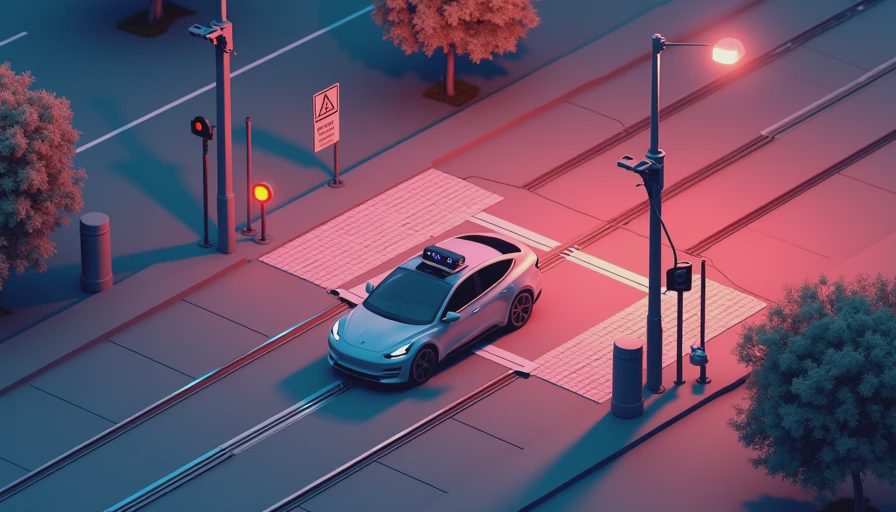
A reasonable tesla fsd railroad crossing stack needs more than a railroad-crossing sign in the image. It should identify the crossing zone, track the road surface through the rails, understand the lane path, and react to active warning devices. Flashing red lights, lowered gates, bells, stopped traffic, and a train should all raise the predicted risk, even if the lane ahead appears open.
The planning problem is harder than ordinary stop-sign behavior. A camera can detect a gate, but detection is only the first layer. The planner must connect that object to a rule: stop before the marked limit line, remain stopped while the gate is down or lights are active, and avoid entering the crossing when traffic ahead leaves no room to clear it. That last condition is a classic occupancy problem, not a cosmetic detail.
I grade these events on a five-point severity scale. Severity 1 is a harmless hesitation. Severity 2 is a poor lane choice or late correction. Severity 3 means the driver must intervene to preserve a safe margin. Severity 4 is an imminent conflict requiring immediate braking or steering. Severity 5 is contact, a near miss, or behavior that would likely produce one without human intervention.
The test procedure I use
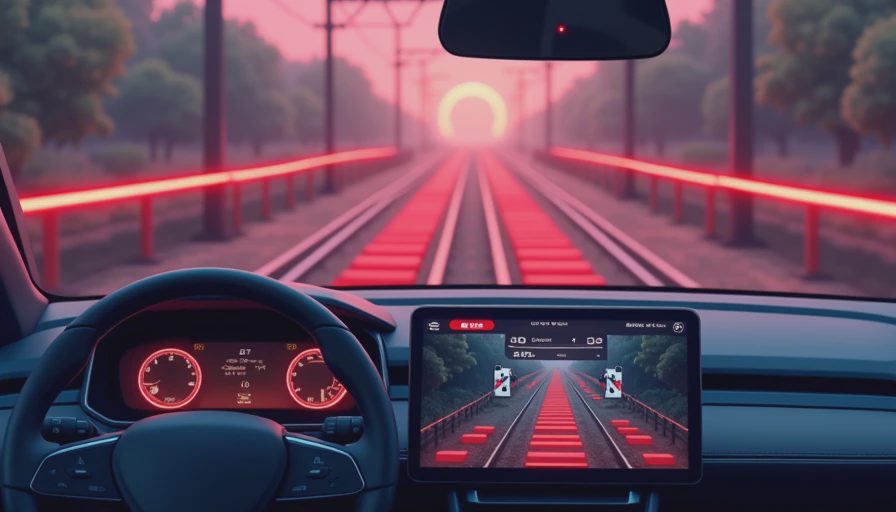
For a tesla fsd railroad crossing run, I record the vehicle software version, hardware configuration, weather, time of day, road markings, traffic, and whether the warning system is active. I also capture forward-facing video and a cabin view when possible. Without those fields, an anecdote becomes nearly impossible to reproduce.
The first pass is an approach with no intervention. The driver keeps hands and attention ready, but does not coach the system through the crossing. I mark the first visible sign, the first visible gate or signal, the braking onset, the final stopping position, and the point where the vehicle resumes. A second pass changes only one variable, such as a vehicle ahead blocking the signal or a low sun angle. A third pass checks whether the behavior was deterministic.
That last step is essential. I ran related perception scenarios three times and got three different answers, and that variation is itself a result. If the car stops correctly only when a gate is clearly silhouetted against the sky, the headline should not be “crossing solved.” The useful finding is that contrast and viewpoint changed the outcome.
A safe baseline is simple: approach at a controlled speed, stop behind the line when required, wait for the gate to rise and signals to stop, then confirm the route is clear. If the car accelerates toward an active crossing, the human should brake immediately rather than wait for a promised intervention.
Common failure modes around railroad tracks
The most obvious failure is failing to stop for an active crossing. More subtle problems deserve the same scrutiny. A vehicle can stop beyond the limit line, creep while the gate is descending, or proceed after the gate rises while a second train remains hidden by the crossing structure. It can also follow a lead vehicle that clears the tracks without checking whether its own exit path is open.
Another concern is route geometry. Some crossings sit at an angle, and the rails can look like lane markings. A system that follows the apparent road edge may drift toward the wrong track or make an unnecessary lateral correction. Road paint, patched asphalt, wet rails, and shadows can further confuse vision-based localization.
Night testing changes the problem again. Reflective signs may bloom in the camera, headlights can mask flashing signals, and the train itself may be difficult to distinguish from background lights. A tesla fsd railroad crossing evaluation that covers only a sunny midday run is incomplete. It measures the easiest slice of the distribution.
The correct response to an ambiguous crossing is conservative behavior: reduce speed, increase following distance, and stop if the warning state cannot be resolved. A confident-looking rollout is not evidence of competence. It may simply mean the model never represented the uncertainty.
What drivers should document after a close call
If a tesla fsd railroad crossing event requires intervention, save the dashcam footage before it is overwritten. Record the date, approximate location, vehicle model, software version, weather, traffic signal state, and exactly what the driver did. “It acted weird” is not a usable bug report. “The gate was down, braking began late, and manual braking stopped the car 12 feet before the rail” is.
Do not intentionally recreate a dangerous event for content. A controlled observation from a safe distance is useful; driving into an active crossing to prove a point is not. Report a serious event through Tesla's available channels and, when appropriate, notify local authorities. If there is a collision, preserve photographs, video, witness information, and the police report.
Insurance follows the incident, not the marketing label. A driver using FSD remains responsible for operating the vehicle, and coverage depends on the policy, state rules, fault determination, and the facts of the crash. Liability coverage can address damage or injuries the driver causes to others, while collision coverage generally addresses damage to the insured Tesla after a covered crash, subject to the deductible. Neither is a substitute for active supervision.
The practical scorecard
My pass criteria for a tesla fsd railroad crossing test are deliberately boring. The car identifies the crossing early, approaches at a manageable speed, stops before the limit line when signals require it, holds position through the warning state, and proceeds only when the route is clear. The driver should not need to guess whether the system saw the train.
A failure gets a reproducible label: missed detection, late braking, bad occupancy planning, lane geometry, or inconsistent state transition. That vocabulary is more useful than calling an update “better.” It tells us which subsystem needs work and what the next test should isolate.
The conclusion is not that every Tesla will behave identically. Software versions, hardware, road design, weather, and training-data coverage all matter. The conclusion is narrower and more actionable: treat every tesla fsd railroad crossing approach as a supervised driving task with a human-ready brake pedal. Your car talks. I check his homework.