Ann Arbor, MI — 7:12 a.m. I keep coming back to tesla model y robotaxi waymo competition because it is the cleanest way to separate ambition from deployment. One side is a consumer SUV with a lot of software promise and a big robotaxi story attached to it. The other side is a real driverless ride-hail service with paid passengers, mapped operating areas, and a stack built for that job. If you want hype, both sides can provide it. If you want a scorecard, the gap is easier to see than the marketing blur.
Why tesla model y robotaxi waymo competition is not an apples-to-apples test
The first mistake people make is treating these two systems like they are solving the same problem in the same way. They are not. Tesla is trying to turn a mass-market vehicle platform into a broad autonomy story that can live in customer cars. Waymo is running a managed mobility service with defined boundaries, fleet control, and a much heavier sensor suite. That difference matters more than the badge on the hatch.
When I score autonomy systems, I do not start with the press release. I start with the operating envelope. Where does the vehicle work, how often does it need help, and what kind of corner case breaks it? In that framework, Waymo is already in the deployment phase. Tesla is still in the prove-it phase for full driverless service. That does not make Tesla irrelevant. It just means the comparison needs a clean label.
The practical question is not which company has the better demo clip. It is which system can handle a messy Tuesday: school pickup traffic, sun glare, a blocked lane, a delivery van double-parked at the curb, and a cyclist entering from a blind angle. That is where the real engineering lives.
What the Model Y brings to the fight
The Model Y has one advantage that does not show up in a lab notebook: scale. Tesla can put the same base vehicle in a huge number of driveways, keep the hardware relatively simple, and push software updates over the air. That creates a fast feedback loop, which is valuable when the whole strategy is to improve the stack through fleet data.
The tradeoff is obvious to anyone who has spent time around perception systems. A lighter sensor bill of materials is cheaper and cleaner, but it leaves less room for redundancy when visibility drops or the scene gets weird. Camera-based driving can be very good in ordinary conditions. It gets more interesting when the scene stops being ordinary: low sun, rain spray, faded lane paint, a left turn across traffic, or a pedestrian stepping out from behind a tall van.
That is where I start paying attention to intervention rate and recovery quality. Not whether the car got surprised once. Every system gets surprised. The useful question is whether it recovers with calm, legible behavior or makes a second mistake while trying to fix the first one. On my severity scale, that is a 4/5 problem in mixed urban traffic.
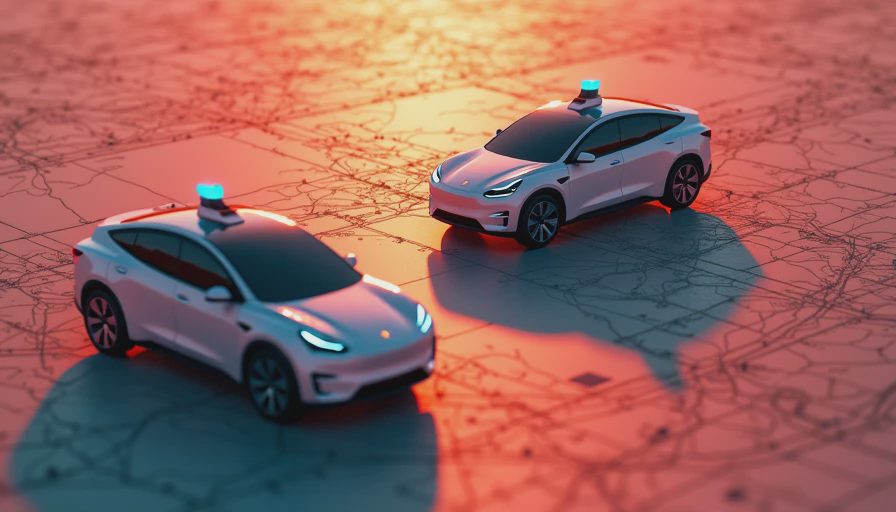
Why Waymo still owns the driverless side
Waymo’s strength is not mystery; it is redundancy and discipline. The vehicle is packed with sensors that give it more than one way to understand the world, and the service is constrained to places where the company can map, monitor, and tune the system. That is why it can put riders in the car without a human safety driver in markets like Phoenix, San Francisco, Los Angeles, and Austin.
That operating model looks less glamorous than a coast-to-coast promise, but it is real autonomy in the only sense that matters to a rider: the car shows up, drives the route, and does not need a person to save it. The system is not trying to win a forum argument. It is trying to complete trips reliably.
The downside is that Waymo pays for that reliability in complexity and geography. More hardware, more calibration, more operational overhead, and a narrower service area than a consumer car can claim. In other words, Waymo wins the current driverless contest, but it does so by accepting a business model that is harder to scale than a retail vehicle sale.
The sensor stack matters more than the badge
This is the part where a lot of public debate gets sloppy. People talk about Tesla versus Waymo like it is a personality contest. It is really a sensor and operations contest. Tesla is betting that vision, software scale, and a huge consumer fleet can eventually beat a heavier hardware stack. Waymo is betting that a more redundant stack and a tightly managed service will keep winning in the real world.
Both bets make sense from an engineering standpoint. The question is where each one pays off first. In dense urban service, extra sensing helps with weird shadows, occlusions, and low-light edge cases. In consumer ownership, lower hardware cost and cleaner packaging matter a lot more. That is why the same technical choice can look brilliant in one product and mediocre in another.
If you are building a scorecard, you should separate latency, perception confidence, and planning quality from business model. A car can make a clean lane change and still be the wrong product for robotaxi service. A fleet can run a safe route and still be too expensive to expand quickly. The badge on the hood does not solve that math.
What this means for riders, owners, and insurers
For riders, the answer is straightforward. A Waymo trip is closer to a transit product than a personal ownership product. You summon it, it drives itself, and the service provider owns the operational risk. That changes expectations around reliability, cleaning, routing, and pickup behavior.
For owners, the Model Y story is different. A personal vehicle with advanced driver assistance is still a personal vehicle. Normal auto insurance still matters, and so does the distinction between private use and commercial use. If someone tried to turn a retail Model Y into a paid robotaxi without the right coverage, a standard personal policy would be the wrong tool. That is where commercial auto, livery, or fleet coverage enters the chat.
For insurers, the interesting part is not the headline. It is repair cost, calibration time, and claim frequency. A vehicle with lots of cameras and tight software coupling can be expensive to put back in service after a hit, even when the damage looks minor from ten feet away. Fleets care about uptime. Private owners care about premiums and deductibles. Those are different products, even if the cars look similar in a parking lot.
My scorecard on the race
Here is the clean version. If you are asking who has a true robotaxi product today, Waymo wins. If you are asking who has the bigger consumer-scale vehicle platform and the louder path to mass deployment, Tesla has the bigger canvas, but not the same level of driverless proof.
That is the real lesson of tesla model y robotaxi waymo competition: one side has scale ambition, the other has a service you can hail right now. I care less about who says they will dominate and more about who can handle the ugly edge cases without a human cleaning up the mess. Here’s what happened. Here’s what it should have done. Here’s the gap. Your car talks. I check his homework.