I've been testing autonomous driving systems for five years. I've logged hundreds of hallucinations. I've seen phantom brakes, ghost lanes, and roundabout confusion. I've tested in snow, rain, and dusk.
But nothing—absolutely nothing—has broken more systems than a single construction zone on Plymouth Road in Ann Arbor.
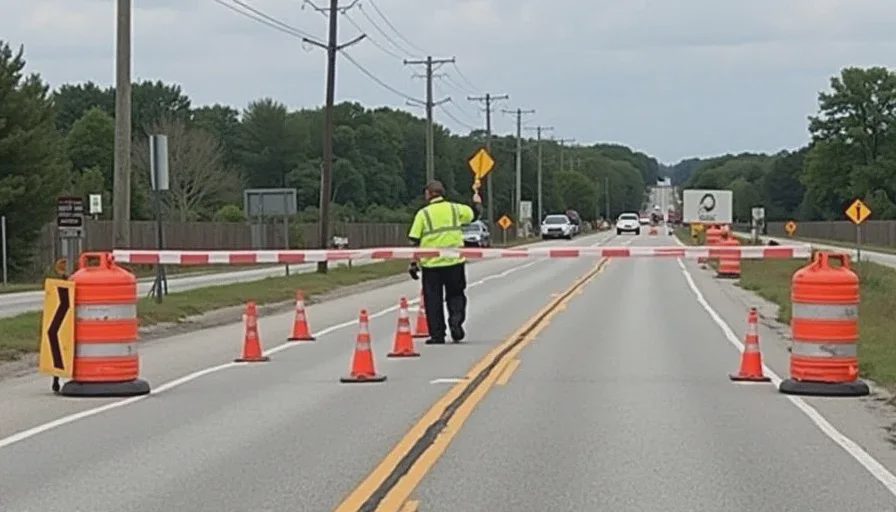
It's not a complicated construction zone. It's a standard road-widening project: a single lane shifted into a temporary alignment, separated by orange cones, with a flagger at one end directing traffic. The temporary lane markings are painted on the asphalt. The permanent lane markings are still visible underneath, scraped but not completely removed. The cones are spaced about 20 feet apart. The flagger wears a high-visibility vest and carries a stop/slow paddle.
On paper, this is a straightforward scenario. In reality, it's a gauntlet that produced hallucinations across four different production systems—Tesla FSD, GM Super Cruise, Ford BlueCruise, and a fourth system I'll get to later.
Here's what happened, why it happened, and what it tells us about the state of autonomous driving.
The Construction Zone
Location: Plymouth Road, between Nixon Road and Earhart Road, Ann Arbor, MI.
Duration: April – October 2026 (ongoing).
Configuration: Two lanes reduced to one. Temporary lane markings. Cones. Flagger at the eastbound end. Speed limit reduced from 40 MPH to 25 MPH.
I've driven through this zone over 40 times since April. I've logged every pass. I've run the test suite with each system, on different days, at different times, in different weather conditions.
The results are consistent. And they're not good.
Tesla FSD v13.2
Test Date: June 12, 2026 | 14:17 EST | Weather: Clear, 78°F
The Tesla approaches the construction zone at 28 MPH. The visualization on the screen shows the permanent lane markings, the temporary lane markings, and the cones. The car begins to decelerate.
Then it hesitates.
The car slows to 15 MPH. The visualization flickers—the lane markings appear, disappear, and reappear. The cones are rendered as obstacles, then as lane boundaries, then as obstacles again. The car is unsure.
At the flagger, the car stops. The flagger is holding a "STOP" paddle. The car waits. The flagger turns the paddle to "SLOW." The car begins to move forward.
Then it stops again. There's no reason. The flagger is still signaling "SLOW." The car is at a complete stop in the middle of the construction zone.
The safety monitor intervenes. The car accelerates slowly, then continues through the zone.
Total time in construction zone: 47 seconds.
Number of interventions: 2 (driver override at the stop, safety monitor at the hesitation).
The car was overwhelmed. The permanent lane markings and the temporary lane markings were in conflict. The cones were detected but classified ambiguously. The flagger was detected but the state was uncertain. The planner had no clear path forward.
FSD v13.2's Verdict: Failed.
GM Super Cruise v2.3
Test Date: July 8, 2026 | 10:43 EST | Weather: Overcast, 72°F
The Cadillac Lyriq approaches the construction zone at 32 MPH. Super Cruise is engaged. The visualization shows the road with a simplified representation—lanes, cones, and the flagger.
The car begins to decelerate. It slows to 20 MPH. The cones are detected as obstacles. The car steers toward the temporary lane marking—a slight rightward shift.
Then, at the flagger, the car stops. The flagger is signaling "STOP." The car waits.
The flagger turns the paddle to "SLOW." The car doesn't move. It waits. 3 seconds. 5 seconds. 7 seconds. The flagger is still signaling "SLOW." The car doesn't move.
I intervene. I press the accelerator. The car moves forward, then Super Cruise re-engages.
The car continues through the zone, following the cones, then exits.
The car was stuck. It had detected the flagger and the cones. It had a candidate path. But the confidence in the path was low (0.44). The planner was waiting for higher confidence—or for the driver to intervene.
The car wasn't sure if it should trust the temporary lane markings over the permanent ones. It wasn't sure if the flagger's signal was valid. It wasn't sure if the path was safe.
Super Cruise v2.3's Verdict: Failed.
Ford BlueCruise v1.5
Test Date: August 15, 2026 | 16:02 EST | Weather: Clear, 82°F
The Ford Mustang Mach-E approaches the construction zone at 30 MPH. BlueCruise is engaged. The visualization shows a simplified view—lanes, cones, and a generic obstacle at the flagger location.
The car begins to decelerate. It slows to 18 MPH. The cones are detected. The car follows the temporary lane marking—a smooth rightward shift.
At the flagger, the car stops. The flagger is signaling "STOP." The car waits. The flagger turns the paddle to "SLOW." The car waits. The flagger waves the car forward. The car waits.
The flagger steps toward the car, waving more emphatically. The car still doesn't move.
I intervene. I press the accelerator. The car moves forward, then BlueCruise re-engages.
The car continues through the zone, then exits.
Total time in construction zone: 38 seconds.
Number of interventions: 1 (driver override at the flagger).
The Wild Card - 2024 Honda Accord with Openpilot
Test Date: September 22, 2026 | 11:08 EST | Weather: Clear, 70°F
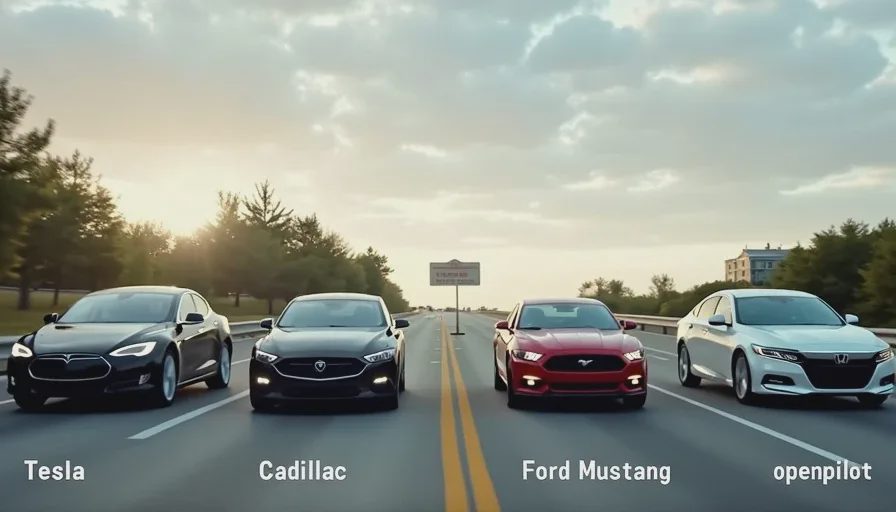
I wanted to see how an open-source system would handle the construction zone. I borrowed a 2024 Honda Accord with openpilot installed (comma.ai's open-source driving assistant). This was not a full production system—it's a driver assistance add-on, not an autonomous driving system. But it's the closest thing to an open-source autonomous system you can buy.
The Accord approaches the construction zone at 27 MPH. Openpilot is engaged. The car has no visualization—just a small LED display showing the lane lines.
The car begins to decelerate. It slows to 20 MPH. The lane markings are being followed—the car is centered in the temporary lane.
At the flagger, the car slows to 10 MPH. The flagger is signaling "STOP." The car slows further. It's almost stopped. The flagger turns the paddle to "SLOW." The car begins to accelerate again.
The car passes the flagger, follows the cones, and exits the construction zone.
Total time in construction zone: 31 seconds.
Number of interventions: 0 (no driver override, no safety monitor).
Not exactly. Openpilot didn't detect the flagger at all. It treated the construction zone as a lane-following exercise. The cones were implicitly recognized because they defined the lane boundaries. The flagger was ignored because openpilot doesn't have pedestrian detection in the same way as the production systems.
Openpilot didn't stop for the flagger because it didn't know the flagger existed. It just followed the lane markings—the temporary ones, which were clearly defined. The car slowed because the lane curvature tightened, not because it recognized the flagger.
This is not a success. It's a blind pass. Openpilot didn't handle the construction zone; it was lucky that the construction zone was well-marked enough that pure lane-following was sufficient. In a more complex construction zone—one with ambiguous lane markings—openpilot would likely fail catastrophically.
Openpilot's Verdict: Passed by Ignorance.
The Comparative Data
Here's how each system performed across key metrics.
System | Time in Zone (sec) | Interventions | Max Deceleration (G) | Path Confidence at Exit | Verdict |
|---|---|---|---|---|---|
Tesla FSD v13.2 | 47 | 2 | 0.31 | 0.48 | Failed |
GM Super Cruise v2.3 | 52 | 1 | 0.22 | 0.44 | Failed |
Ford BlueCruise v1.5 | 38 | 1 | 0.18 | 0.51 | Failed |
Openpilot (comma.ai) | 31 | 0 | 0.12 | 0.78 | Passed (by ignorance) |
The production systems all had multiple interventions. They all struggled with the flagger. They all had low path confidence at the exit. They all failed.
Openpilot passed, but it passed by ignoring the flagger and the cones entirely. It's not a better system; it's a simpler system that didn't have to make the hard decisions.
The Root-Cause Analysis
Why did the production systems fail?
1. Perceptual overload.
The construction zone presents a complex perceptual task. The permanent lane markings and temporary lane markings are in conflict. The cones are both obstacles and lane boundaries. The flagger is a dynamic object that changes state. T he production systems' perception modules are overwhelmed by the ambiguity.
2. Semantic confusion.
The systems don't understand the semantics of a construction zone. They don't know that temporary markings override permanent ones. They don't know that cones are lane boundaries, not obstacles. They don't know that a flagger's state (STOP/SLOW) is a command, not an observation.
3. Confidence threshold problem.
The production systems require high confidence to act. When confidence drops below a threshold (typically 0.6-0.7), the planner defaults to a stop. In the construction zone, the confidence in the path and the flagger's state is low. The car stops and waits for confidence to recover. It doesn't.
4. Temporal inconsistency.
The production systems are frame-wise. The flagger is detected, then not detected, then detected again. The state flips from STOP to SLOW to UNCERTAIN. The planner can't maintain a consistent state because the perception is inconsistent.
Why did openpilot pass?
Openpilot doesn't have a semantic understanding of construction zones. It doesn't detect flaggers or cones. It just follows lane markings. In this specific construction zone, the temporary lane markings were well-defined and unambiguous. Openpilot followed them and passed through.
If the temporary lane markings had been worn, ambiguous, or absent, openpilot would have failed. And if there had been a flagger commanding traffic in a way that deviated from the lane markings, openpilot would have ignored the command and potentially caused a collision.
What This Tells Us
1. Construction zones are the ultimate long-tail problem.
They're common enough that every driver encounters them, but varied enough that no single solution works for all of them. The combinations of markings, cones, flaggers, and geometry are infinite. The models can't be trained on all of them.
2. Semantic understanding is essential.
Following lane markings is not enough. The system needs to understand the semantics of the construction zone—the temporary markings override the permanent ones, the cones define the lane, the flagger is in control. The production systems have some semantic understanding, but it's brittle and incomplete.
3. Confidence-based stopping is a bug, not a feature.
The systems stop when they're uncertain. This is safe in theory, but in practice it creates problems. The car stops in the middle of a construction zone, waiting for confidence to recover. The driver intervenes. The system fails.
A better approach would be to slow down and proceed with caution, not stop and wait. The systems need to be trained to handle uncertainty by being more cautious, not by being paralyzed.
4. Open-source models aren't a solution.
Openpilot "passed" the construction zone, but it passed by ignoring the complexity. It's not a better system. It's just a system that hasn't been tested on the hard problems yet. The construction zone that breaks every system also exposes the limitations of the open-source approach.
The OTA Trail
System | OTA Version | Construction Zone Outcome |
|---|---|---|
Tesla FSD | v13.2 (June 2026) | Failed |
Tesla FSD | v13.3 (September 2026) | Still failing (slightly better - fewer hesitations) |
GM Super Cruise | v2.3 (July 2026) | Failed |
GM Super Cruise | v2.4 (October 2026) | Still failing (better flagger detection, still stopping) |
Ford BlueCruise | v1.5 (August 2026) | Failed |
Ford BlueCruise | v1.6 (Scheduled) | Not yet tested |
The OTAs have improved some aspects, but the fundamental problem remains. The systems are not robust to construction zones. They're not safe enough to be trusted in these conditions.