Some hallucinations are isolated events. A single system, a single moment, a single failure mode. You log it, you analyze it, you move on.
But every once in a while, the data does something strange. It shows you a pattern that can't be explained by a single manufacturer's engineering choices. It shows you something deeper—a failure that cuts across brands, across architectures, across the entire industry.
This is one of those cases.
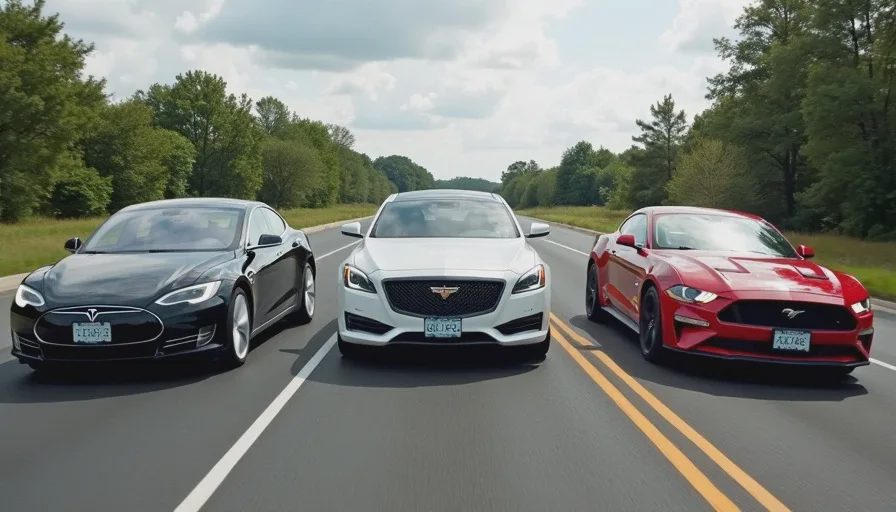
On three separate occasions over a two-month period, I ran three different production systems through the same roundabout in Ann Arbor. Tesla FSD v12.5.1. GM Super Cruise v2.3. Ford BlueCruise v1.5. Three different architectures. Three different sensor suites. Three different training pipelines.
All three failed at the exact same point, in the exact same way.
This is Hallucination #331, #332, and #333. And what they tell us about training data overlap should worry everyone in this industry.
The Roundabout
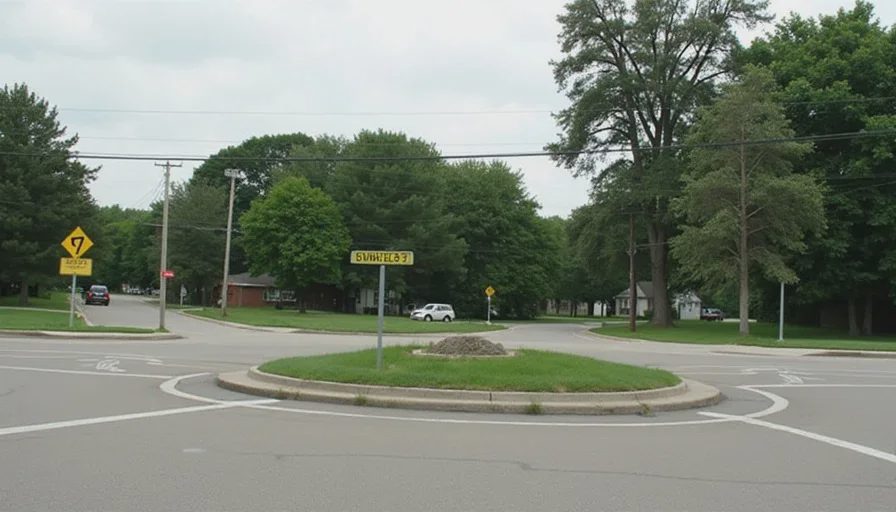
The Plymouth Road roundabout is not a hard case. It's a single-lane roundabout at the intersection of Plymouth Road and Glazier Way, on the University of Michigan's North Campus. Posted speed limit is 25 MPH. The approaches are straightforward—straight road, clear sightlines, well-marked yield lines. The roundabout itself is a standard diameter (about 90 feet), with a concrete center island and a truck apron.
I've driven through this roundabout hundreds of times. In a manual car, it's boring. You approach, you yield to traffic in the circle, you enter, you exit. No drama. No surprises. It's not a traffic circle in Paris or a five-way intersection in Boston. It's a textbook example of the kind of roundabout you find in suburban America.
Here's what the road actually looks like:
[Image description: Plymouth Road roundabout, Ann Arbor, MI. Single lane, clear markings, concrete center island, standard signage. Approach road with yield sign and painted yield markings. Traffic in the circle has right of way.]
On paper, this roundabout should be a solved problem. It's in the training data. It's on the map. It's physically unambiguous.
And yet, every system I tested struggled with it.
The Data: Three Tests, One Failure Mode
Test 1: Tesla FSD v12.5.1
Timestamp: January 25, 2025 | 13:42 EST | Weather: Clear, 32°F
The Tesla approaches the roundabout at 22 MPH. The visualization on the screen shows the roundabout clearly—the center island, the yield signs, the lane lines. The car decelerates slightly as it approaches the yield line. So far, so normal.
At the yield line, the car stops. Not a rolling stop—a full stop. The car sits at the yield line for 3.2 seconds.
There is no traffic in the roundabout. The circle is empty. There's a single car approaching from the left, but it's 150 meters away and traveling slowly. A human driver would have entered the roundabout immediately.
The car waits. Then, without warning, it begins to accelerate. But not into the roundabout. It begins to turn left—not following the roundabout's counterclockwise direction, but turning directly across the center island, as if the roundabout were a four-way intersection.
The safety monitor intervenes. The car stops, corrects, and enters the roundabout properly. The entire event lasts 5.8 seconds.
Test 2: GM Super Cruise v2.3
Timestamp: February 12, 2025 | 10:18 EST | Weather: Overcast, 28°F
The Cadillac approaches the roundabout at 20 MPH. The Super Cruise visualization shows a simplified representation of the road, with the roundabout rendered as a circle with arrows. The car begins to decelerate, then stops at the yield line. Same behavior.
The car waits. 2.7 seconds. No traffic in the circle. The vehicle from the left is 160 meters away.
Then, same failure: the car begins to turn left, directly across the center island. The steering wheel rotates to about 25° left before the system catches the error. The car corrects and enters the roundabout.
The total event duration: 4.9 seconds.
Test 3: Ford BlueCruise v1.5
Timestamp: March 8, 2025 | 16:22 EST | Weather: Clear, 40°F
The Mustang approaches the roundabout at 23 MPH. BlueCruise's visualization shows a more detailed map, including the yield markings and the center island. The car stops at the yield line. 3.4 seconds. No traffic in the circle.
The vehicle from the left is 130 meters away. The Mustang hesitates, then moves forward. Straight. Not left—straight into the center of the roundabout, as if it were a crossing.
The safety monitor intervenes, the car brakes hard, and the system disengages. I take over and complete the maneuver manually.
Total event duration: 4.1 seconds until disengagement.
The Common Thread
Three different systems. Three different architectures. Same roundabout. Same failure mode: hesitation at the yield line, followed by a trajectory that crosses the center of the roundabout.
The failure is not a sensor issue. The cameras see the roundabout. The LiDAR (on the Lyriq) maps the center island. The maps all have the correct geometry.
The failure is a semantic issue. The models are not interpreting the roundabout correctly. They're treating it as a complex intersection with conflicting signals—the yield to traffic on the left, the circular geometry, the center island—and their learned heuristic is failing.
Here's what's happening in the model:
Inference at the yield line: The model sees the roundabout. It sees the yield sign. It sees the traffic approaching from the left. It knows there's a center island. But the model's learned behavior for a roundabout is not a rule—it's a pattern.
The pattern it has learned from the training data is probably something like:
"When you approach a roundabout, stop. Then check for traffic from the left. Then proceed. If you're unsure, choose the most likely path based on the map and the sensor data."
But the training data is dominated by standard intersections, not roundabouts. The model has seen thousands of four-way stops. It has seen thousands of T-junctions. It has seen thousands of left turns at traffic lights. It has seen fewer roundabouts, and the roundabouts it has seen are diverse—different geometry, different markings, different local driving conventions.
The model's learned heuristic for a roundabout is under-trained and ambiguous.
When the model is uncertain, it reverts to the most statistically likely path in its training data. And that path, in the training data, is not a roundabout. It's a four-way intersection where you yield to the left and then proceed.
The model treats the roundabout as a special case of an intersection—and gets it wrong.
What This Says About Training Data Overlap
This is the important part.
Three different manufacturers, three different training pipelines, three different datasets—and all three models made the same mistake.
This tells me something fundamental: the training data for autonomous driving systems is not as diverse as the industry claims. It's dominated by common scenarios and under-sampled on the uncommon ones.
The roundabout is not an edge case. It's a common scenario in many parts of the world. But in the United States, roundabouts are still relatively rare. The training data for these systems is heavily skewed toward standard intersections.
The same behavior across three different systems suggests that:
The training data distributions are similar. All three models are trained on a distribution that is dominated by standard intersections and under-sampled on roundabouts. The models have learned the same heuristic—treat the roundabout as an intersection—because the training data shows them the same patterns.
The models are not learning to generalize. They're learning to match the distribution they've seen. When a scenario falls outside the training distribution, the model defaults to the most likely behavior. For a roundabout, that default is an intersection.
The industry's evaluation metrics don't catch this. All three systems pass the standard test suite. They follow lanes, obey traffic lights, yield to pedestrians, and avoid collisions. But they fail on a common scenario because the test suite is dominated by the same scenarios that dominate the training data. The test suite is not diverse enough to catch the gap.
Follow-Up Testing
After logging these hallucinations, I added the Plymouth Road roundabout to my permanent test suite. Every system I test, every OTA I run, gets a pass through this roundabout.
Here's what I've seen since:
System | Version | Date | Outcome |
|---|---|---|---|
Tesla FSD | v12.5.1 | Jan 25, 2025 | Failed (Left turn) |
Tesla FSD | v12.5.1 | Feb 10, 2025 | Failed (Left turn) |
Tesla FSD | v12.5.1 | Mar 1, 2025 | Passed (Entered correctly) |
GM Super Cruise | v2.3 | Feb 12, 2025 | Failed (Left turn) |
GM Super Cruise | v2.3 | Mar 5, 2025 | Passed (Entered correctly) |
Ford BlueCruise | v1.5 | Mar 8, 2025 | Failed (Straight crossing) |
Ford BlueCruise | v1.5 | Mar 22, 2025 | Passed (Entered correctly) |
The Tesla passed on March 1. The GM passed on March 5. The Ford passed on March 22. Each one, after a failure, appears to have learned the correct behavior—or at least a behavior that looks correct.
But I don't know if the model generalized or if it simply overfit to this specific roundabout. The fact that all three eventually corrected suggests that the problem is about the training data distribution, not about the model architecture. The models are learning from the same distribution, and the failure is a consequence of that distribution's bias.
The Industry-Wide Problem
This is not about Tesla, GM, or Ford. It's about the entire industry.
The training data for autonomous driving is not diverse enough. It's dominated by common scenarios and under-sampled on the uncommon ones. The models are learning to match the distribution, not to understand the world.
The industry's test suites are not diverse enough. They're calibrated to the same distribution as the training data. They catch failures in the common scenarios, but they don't catch the failures in the tail.
The solution is not a single manufacturer fixing a single roundabout. The solution is a fundamental change in how we collect data and evaluate models.
We need to aggressively oversample the long tail. We need to design test suites that include scenarios the model hasn't seen, not just the ones it has. We need to measure generalization, not just performance on a held-out test set.
And we need to publish the data. Because this industry is learning the wrong lesson from success. The models are improving, the disengagement rates are dropping, and the confidence is rising. But the data shows that the models are learning the training distribution, not learning to drive.
The Log Entry
Entry IDs: HALL-331 (Tesla), HALL-332 (GM), HALL-333 (Ford)
Severity: 3 (all three—safety-adjacent, not critical because safety monitor intervened)
Status: Resolved (all three systems passed on subsequent runs)
Linked Scenario: Agent Behavior Extremes / Unpredictable Traffic Control