At 7:42 a.m. on a wet Ann Arbor road, a Tesla autonomous driving system faced an ordinary problem: a lane line disappeared under patched asphalt while a delivery van blocked the shoulder. The interesting question was not whether the car could follow a clear highway. It was whether the system could preserve a sensible trajectory when its visual context became ambiguous. That is where marketing language ends and evaluation starts.
Tesla autonomous driving is not one single capability. The phrase can refer to Autopilot, Full Self-Driving features, or the broader software stack that handles steering, speed, lane changes, and turns. These systems remain driver-assistance tools. A human must supervise the vehicle, keep attention on the road, and be ready to take control. Calling a feature autonomous does not remove that responsibility.
What the system is actually being asked to do
A production vehicle has to solve several separate problems at once. Perception estimates where lanes, vehicles, pedestrians, signs, and road edges are. Prediction estimates what nearby agents might do next. Planning selects a path and speed. Controls convert that plan into steering, braking, and acceleration. A failure in any layer can look like a single bad decision from the driver's seat.
Tesla autonomous driving is especially interesting because its behavior changes through over-the-air updates. The hardware may stay fixed while the planner, confidence thresholds, or object-handling logic changes. That makes a single drive a weak source of evidence. A useful test repeats the same route, records weather and traffic conditions, and compares behavior across software versions.
My scorecard uses a severity scale from 1 to 5. Severity 1 is an awkward but harmless action, such as unnecessary hesitation. Severity 3 forces a meaningful driver correction. Severity 5 represents an imminent collision or loss of control. The scale is not a safety certification; it is a way to stop vague impressions from becoming conclusions.
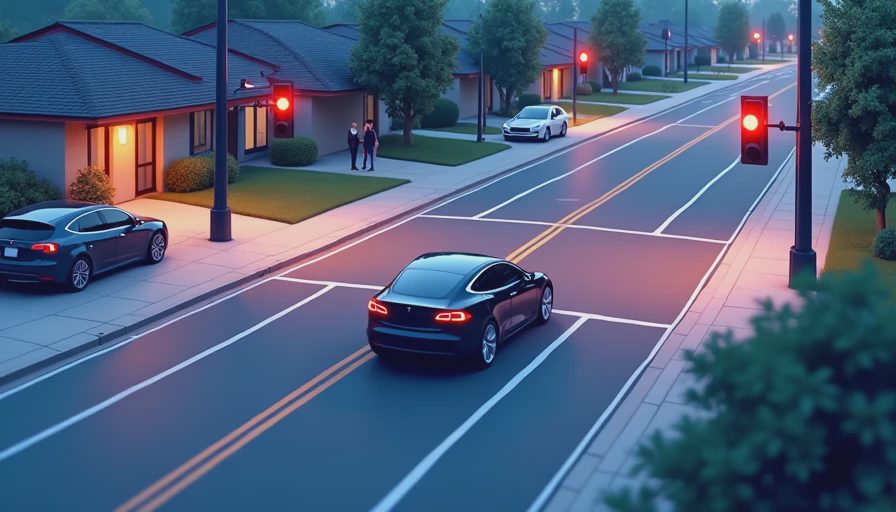
The edge cases matter more than the smooth demo
A clear divided highway is a low-information environment. Lane markings are usually visible, traffic flows in the same direction, and the next maneuver is easy to predict. A system can look excellent there while still failing on the details that make urban driving difficult.
The tougher tests include an unprotected left turn with a partially hidden cyclist, a construction zone with conflicting temporary lines, and a stale green light at a wide intersection. I also watch for parked vehicles that narrow the usable lane, drivers who cut across a turn, and pedestrians standing near but not entering a crosswalk. In each case, I record what happened, what the car should have done, and the gap between those two answers.
One recurring issue in Tesla autonomous driving evaluations is not dramatic failure but inconsistent hesitation. The car may slow for a shadow on one pass, continue normally on another, and request intervention on a third. That inconsistency matters because a driver cannot build a reliable mental model from one successful run. I ran a difficult turn three times and got three different levels of caution. The result was not proof of a regression, but it was a reason to collect more runs.
How I would test an update instead of trusting the release note
Start by freezing the variables. Use the same vehicle, tire setup, route, time window, and approximate traffic pattern. Record the software version before every run. A phone video helps, but synchronized cabin audio and forward video are more useful because they show when the driver intervened and why.
Next, divide the route into events rather than miles. A 10-mile drive with no decisions provides less information than one correctly logged merge. For every event, note the initial scene, requested maneuver, vehicle response, driver correction, and outcome. If the car brakes, capture whether the obstacle was real, misclassified, or simply outside a comfortable stopping margin.
Tesla autonomous driving should be compared against a baseline, not against memory. Run the same scenario manually and, when possible, under the previous software version. This does not produce a controlled scientific experiment; traffic is never identical. It does produce a better signal than saying an update “feels smoother.” Smoother steering can coexist with worse decision timing.
What drivers often misunderstand about capability labels
The word “self-driving” creates a dangerous shortcut in human reasoning. Drivers begin monitoring the car less closely because the system has performed well for several minutes. That is exactly when an unfamiliar construction pattern, emergency vehicle, or stopped object can arrive without enough attention left for a clean intervention.
Tesla autonomous driving features can assist with lane centering, following distance, lane changes, and some navigation tasks, depending on the vehicle, market, configuration, and enabled software. They do not make the vehicle legally or practically independent of its driver. A steering-wheel prompt is not a substitute for active observation, and a successful route does not establish that every route is safe.
The handoff itself deserves testing. Does the warning arrive early enough for a driver who is looking ahead? Is the requested action obvious? Does the car remain stable while the human takes over? A system that handles routine behavior well but produces late, confusing handoffs has a different risk profile from one that makes more conservative requests earlier.
Insurance, maintenance, and ownership decisions
Insurance companies generally rate a vehicle using factors such as location, driving record, claims history, vehicle model, repair cost, and coverage choices. Driver-assistance software does not automatically mean a lower premium. In some cases, advanced sensors, cameras, displays, and specialized body parts can raise repair costs after a collision. Comprehensive coverage addresses non-collision losses such as theft, hail, or falling objects, while collision coverage addresses damage from a crash, subject to the selected deductible.
Before buying or subscribing to a feature, price the complete ownership picture. Ask an insurer how the exact Tesla model and trim are rated, compare a $500 deductible with a $1,000 option, and check whether rental reimbursement is included. Also budget for tires, alignment checks, windshield replacement, and calibration-related work after damage. A lower monthly software bill does not offset a repair gap after a camera or windshield event.
A practical scorecard for prospective buyers
For Tesla autonomous driving, I would ask four questions before treating a demo as evidence. First, what exact feature and software version ran the drive? Second, how many repeatable scenarios have been tested rather than merely filmed? Third, what intervention rate occurred in difficult conditions? Fourth, what failure behavior did the car show when confidence dropped?
A buyer should also test the system in ordinary personal use, not just on a route selected for success. Try a familiar commute, a poorly marked road, a parking lot exit, and a night drive with glare. Keep both hands and attention ready. If the system makes an odd move, disengage cleanly and log it instead of trying to rescue the maneuver while distracted.
My conclusion is deliberately narrower than a product launch claim. Tesla autonomous driving can reduce workload in some repeatable situations, but its performance is conditional and software-dependent. The useful question is not whether the car is “autonomous.” It is where the model succeeds, where it hesitates, and how much warning it gives before the driver must correct it. Your car talks. I check his homework.